
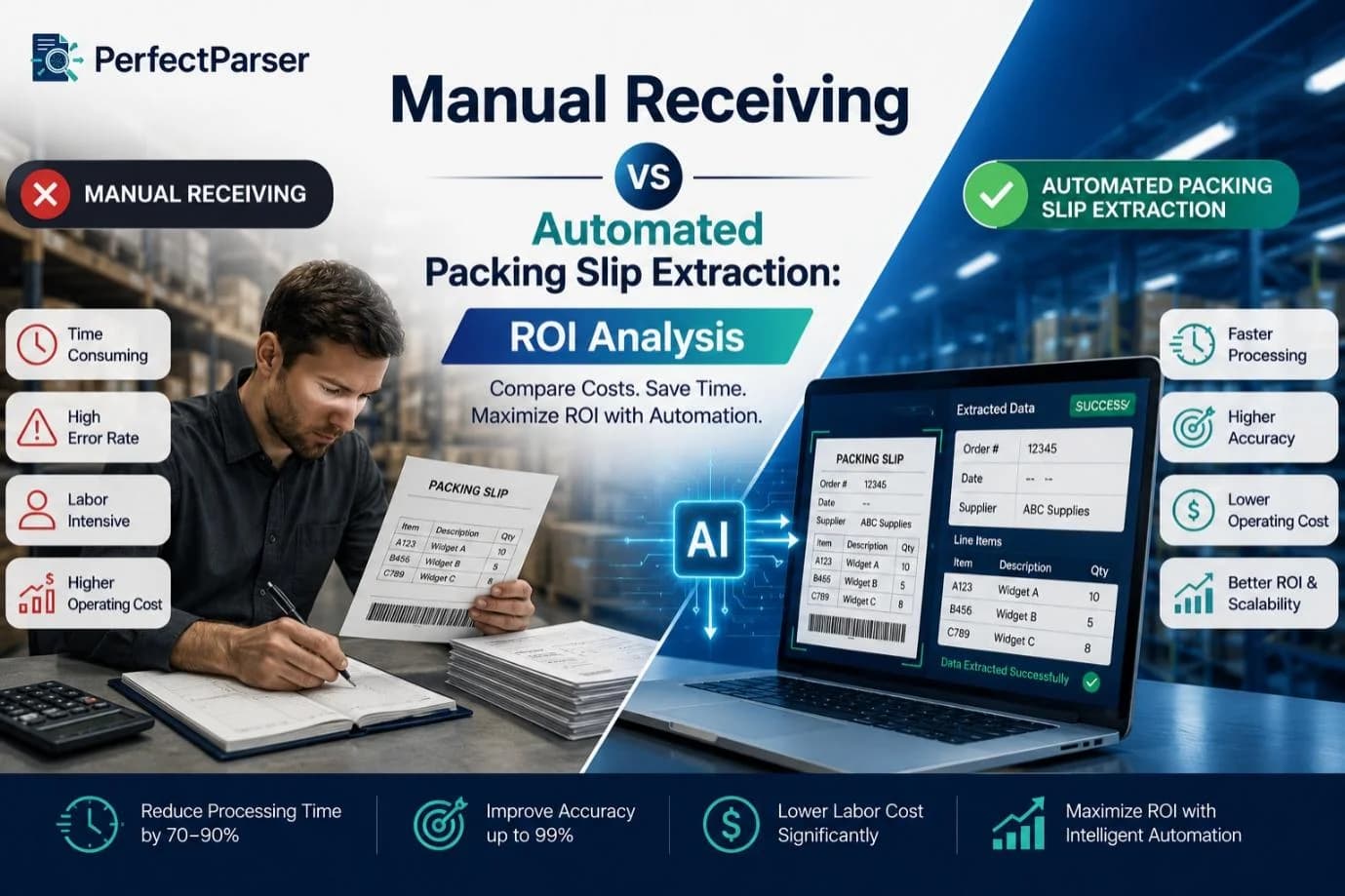
Receiving and processing hundreds of packing slips daily can drain your warehouse team's resources faster than you'd expect. What if most of this work could happen without a single keystroke?
Automated packing slip extraction isn't just a luxury anymore—it's table stakes for businesses handling moderate to high order volumes. Whether you're managing a 50-order or 5,000-order warehouse, the difference between manual data entry and intelligent automation directly impacts your bottom line.
In this guide, we'll walk through how AI packing slip extraction works, break down the real costs of manual processing, calculate your potential ROI with a pay-as-you-go pricing model, and show you exactly what to look for in packing slip data extraction software. By the end, you'll know whether automation makes financial sense for your operation and what implementation looks like.
Understanding the Current Landscape: Manual vs. Automated Receiving
The Reality of Manual Packing Slip Processing
Manual vs Automated Packing Slip Processing has been a constant operational challenge in logistics, but the numbers tell a clear story.
When your team manually processes packing slips, they're typically:
- Physically opening each shipment and locating the packing slip
- Reading and interpreting handwritten, printed, or poorly scanned documents
- Typing data into your inventory management or ERP system
- Cross-referencing with purchase orders to catch discrepancies
- Fixing errors when data doesn't match
- Filing or archiving paperwork
This workflow, repeated hundreds or thousands of times per week, creates several severe bottlenecks:
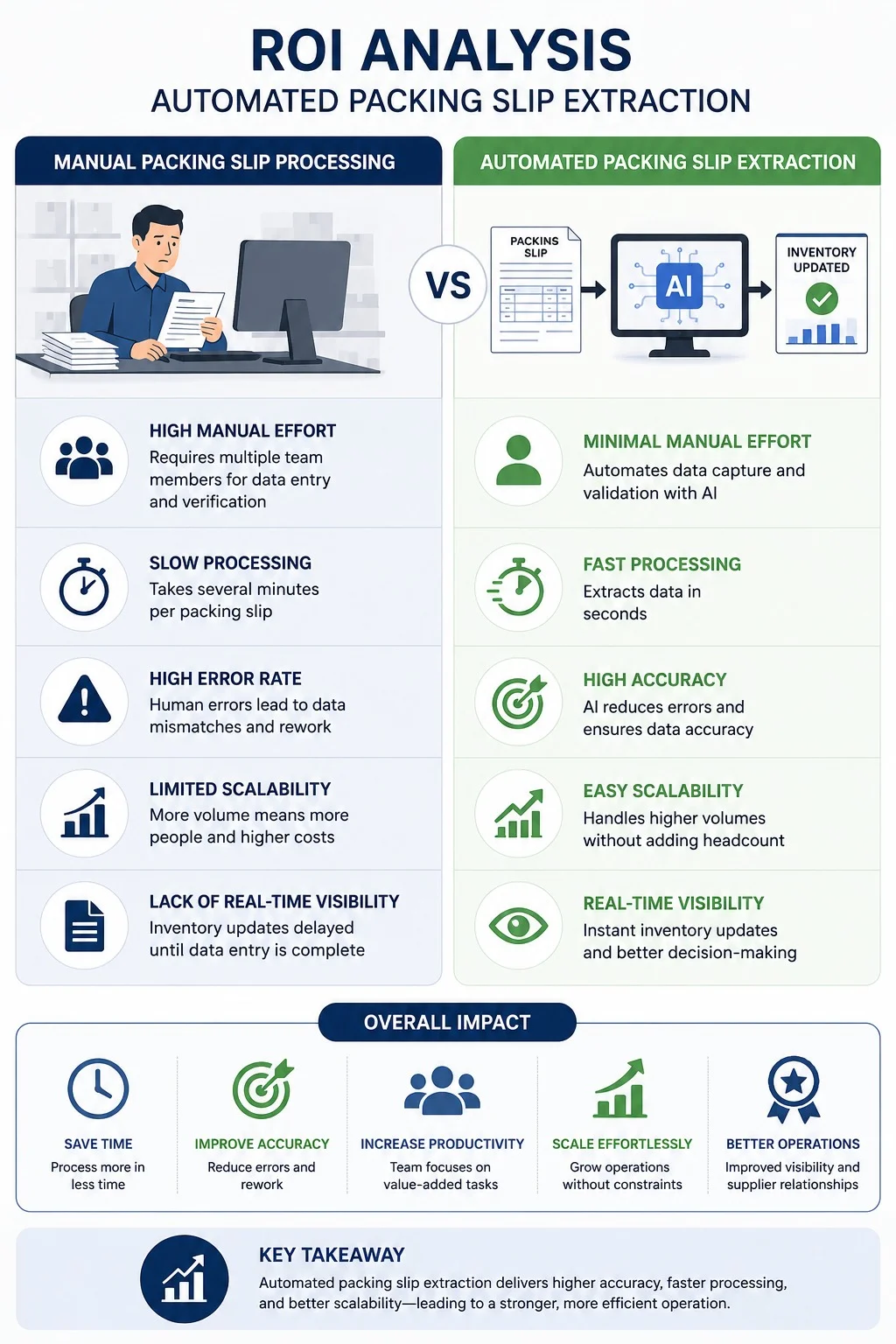
- Time Consumption: A single packing slip takes 3–5 minutes to process manually. Scale that to a warehouse receiving 200 shipments daily, and you're looking at 10–16 hours of pure data entry work per day (~1.67 full-time equivalents).
- Error Rates: Human data entry introduces errors at rates of 2–4%, according to industry benchmarks. A mistyped SKU, quantity, or supplier code triggers inventory mismatches, delayed fulfillment, and costly invoice disputes downstream.
- Labor Costs: Hiring and retaining warehouse staff focused on manual receiving data entry is expensive. Loaded warehouse salaries in major logistics hubs average $42,000–$54,000 annually per employee ($21–$27/hour including benefits and payroll taxes).
- Scalability Ceiling: The more orders you receive, the more staff you need. Space, management bandwidth, and data accuracy become harder to maintain as order volume spikes.
What Is Automated Packing Slip Extraction and How Does It Work?
AI Packing Slip Extraction represents a fundamental shift in how receiving departments operate.
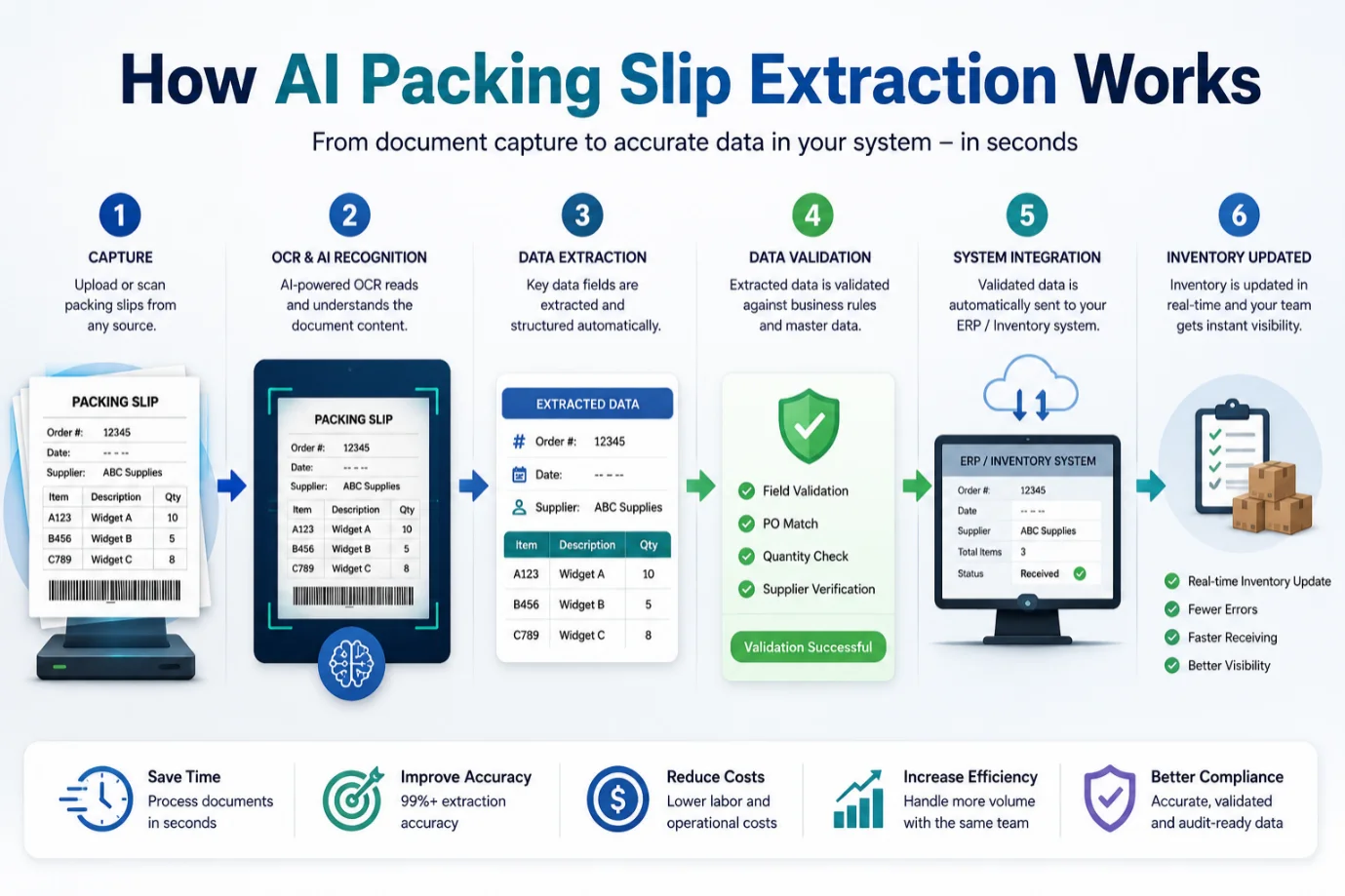
At its core, automated packing slip extraction uses machine learning and optical character recognition (OCR) to:
- Capture packing slips (via scanner, mobile camera, email attachment, or PDF upload)
- Recognize and extract key data fields—order numbers, line-item quantities, SKUs, supplier details, dates, and tracking numbers (see our technical guide on extracting SKUs and quantities from packing slips)
- Validate extracted fields against your ERP master data and purchase orders
- Flag exceptions automatically when data doesn't align (missing items, overages, damaged goods)
- Populate your inventory management, WMS, or ERP system instantly
Modern packing slip data extraction software handles:
- Handwritten entries and varying supplier document formats
- Multi-page packing slips with dense line-item tables
- Multiple languages on a single document
- Poor scan quality, creased paper, or smartphone photos
- Non-standard layouts from hundreds of different vendors
The result? What took 3–5 minutes per slip now takes 10–15 seconds, with extraction accuracy exceeding 98%.
The Financial Case: Calculating Your ROI on Automated Receiving Implementation
Let's move beyond theory and break down the exact math. Here is how to evaluate whether packing slip data extraction software makes financial sense for your warehouse.
Breaking Down the Costs of Manual Processing
Consider a warehouse receiving 200 shipments per day (250 working days = 50,000 slips annually, or ~4,166 slips per month).
1. Labor Costs:
- Average loaded labor cost per warehouse employee: $48,000 annually ($24/hour including benefits and payroll tax)
- 200 packing slips @ 4 minutes per slip = 800 minutes/day = 1.67 Full-Time Equivalents (FTE)
- Annual manual labor cost: $80,160
2. Error and Rework Costs:
- 2% human error rate on 200 daily slips = 4 errors per day
- Each error takes ~30 minutes to diagnose, verify physically, and correct in the system
- 4 errors × 30 minutes = 2 hours of rework daily
- 2 hours × $24/hour × 250 working days = $12,000 annually
3. Workstation & System Access Overhead:
- Workstation, scanning hardware maintenance, and supervision: $2,000 annually
Total Baseline Cost of Manual Processing: ~$94,160 per year (~$7,846/month)
Costs of Implementing Document Automation (Pay-As-You-Go Model)
Unlike legacy enterprise OCR software that demanded $15,000+ upfront licensing and heavy setup contracts, modern cloud AI extraction runs on a flexible pay-as-you-go / usage-based model tied directly to document volume.
1. Pay-As-You-Go Extraction Cost:
- Standard tier pricing: $99/month per 1,000 pages extracted (~$0.08–$0.10 per page)
- For 4,166 packing slips per month (50,000/year): ~$375/month ($4,500/year)
2. One-Time Setup and Integration:
- Lightweight API, Zapier, or WMS connector configuration: $500–$1,000 one-time (let's assume $750)
- Setup takes hours or days, not months.
3. Hardware Requirements:
- $0 (uses existing mobile devices, desktop scanners, or automated email ingestion)
Year 1 Total Investment: ~$5,250 ($4,500 usage + $750 setup)
Year 2+ Annual Recurring Cost: ~$4,500/year (pure usage-based extraction)
The ROI Calculation
By automating data extraction, your receiving staff is freed from data entry and only handles occasional exceptions (e.g., damaged shipments or illegible handwriting). Retaining 0.15 FTE (~1 hour/day) for exception review costs ~$7,200 annually.
Year 1 ROI:
- Baseline Manual Cost: $94,160
- Retained Human Exception Review: $7,200
- Gross Operational Savings: $86,960
- Year 1 Automation Investment: $5,250 ($4,500 usage + $750 setup)
- Net Benefit Year 1: $81,710
- Payback Period: ~23 days (under 1 month)
- Year 1 ROI: ~1,556%
Year 2+ ROI:
- Gross Operational Savings: $86,960
- Recurring Usage-Based Software Cost: $4,500
- Net Benefit Year 2+: $82,460 per year
- Year 2+ ROI: ~1,832%
For almost any operation processing 100+ daily slips, pay-as-you-go packing slip extraction pays for itself within the first month.
Key Benefits Beyond Cost Savings
While raw ROI is compelling, the operational advantages often provide even greater strategic value:
Instant Inventory Visibility
With automated receiving workflows, extracted data hits your WMS/ERP within seconds of physical arrival. Inventory becomes available for order fulfillment immediately rather than sitting on receiving docks waiting for evening data entry batches. In freight and container logistics, eliminating documentation lag delivers similar compounding savings — see how Bill of Lading automation prevents costly port demurrage fees.
Superior Accuracy & Audit Trails
AI packing slip extraction eliminates mistyped SKUs and incorrect unit counts before goods are put away. Built-in validation rules verify incoming quantities against purchase orders, automatically flagging short-shipments or vendor overages.
Frictionless Scalability
During peak seasonal spikes (e.g., Q4 retail), your shipment volume can triple without requiring temporary data entry hires. A pay-as-you-go extraction model scales up and down fluidly with your actual volume.
Improved Employee Morale
Warehouse workers consistently rate manual data entry as one of their most tedious tasks. Automating keying lets your team focus on physical quality control, safety, and inventory optimization.
Common Mistakes When Implementing Packing Slip Data Extraction Software
Even with rapid payback, implementation requires smart execution. Avoid these common pitfalls:
1. Choosing Heavy Enterprise Contracts Over Pay-As-You-Go
Mistake: Signing rigid multi-year enterprise contracts with mandatory $10k+ professional service fees.
Fix: Choose modern cloud AI platforms offering usage-based pricing ($99/mo per 1,000 pages) and self-serve API integrations with low $500–$1,000 setup effort.
2. Neglecting Exception Handling Workflows
Mistake: Expecting 100% straight-through processing without human review rules.
Fix: Define clear exception rules for damaged documents, supplier quantity mismatches, and unlisted SKUs before launching.
3. Decoupling Extraction from Your WMS / ERP
Mistake: Extracting data to CSV files that staff must still upload manually into your ERP.
Fix: Connect AI extraction directly to your WMS, ERP, or inventory system via webhook or REST API so receiving updates happen end-to-end automatically.
Choosing the Right Packing Slip Data Extraction Software: Decision Framework
Not all document capture tools are built equal. Here is what to evaluate:
Real-World Implementation Example: How a Mid-Sized Distributor Scaled Operations
Consider a fast-moving consumer goods (FMCG) distributor receiving 250–300 shipments daily (~5,500 packing slips/month).
The Challenge:
They employed 4 receiving team members, with approximately 2.5 FTEs dedicated strictly to keying packing slips into their ERP. The team averaged 6–10 data entry errors per day, leading to stock discrepancies and vendor invoice friction.
Implementation Steps:
- Pilot (Days 1–3): Tested cloud-based AI packing slip extraction on 100 historical packing slips across 15 key suppliers. First-pass extraction accuracy hit 98.2%.
- Integration (Days 4–7): Connected the AI extraction engine to their WMS using a simple webhook API ($750 one-time setup).
- Go-Live (Day 8): Deployed mobile scanning tablets to the receiving dock.
Results After 90 Days:
- Data Entry Labor Savings: Shifted 2.25 FTEs from manual data entry to physical quality assurance ($9,000/month in reallocated labor).
- Processing Time: Reduced time per packing slip from 4 minutes to 15 seconds.
- Error Rate: Dropped from 3.1% to under 0.2%.
- Pay-As-You-Go Software Cost: ~$500/month (for ~5,500 pages extracted).
- Net Monthly Benefit: $8,500/month net savings ($102,000/year).
Conclusion: Modernize Your Receiving Operation Today
Automated packing slip extraction is no longer reserved for Fortune 500 enterprise warehouses. With flexible pay-as-you-go pricing ($99/mo per 1,000 pages) and minimal upfront setup ($500–$1,000), warehouses receiving as few as 50–100 shipments daily can achieve payback in under 30 days.
The math is straightforward: Manual keying is expensive, error-prone, and slow. Modern AI document extraction is fast, accurate, and costs pennies per page.
Ready to calculate savings for your warehouse? Start by auditing your receiving workflow: How many packing slips do you process daily? How long does keying take? The numbers will quickly show how much automation can save your operation.
Try PerfectParser Free
Extract data from your first documents today. No credit card required — 20 free credits included.
Start Extracting →