
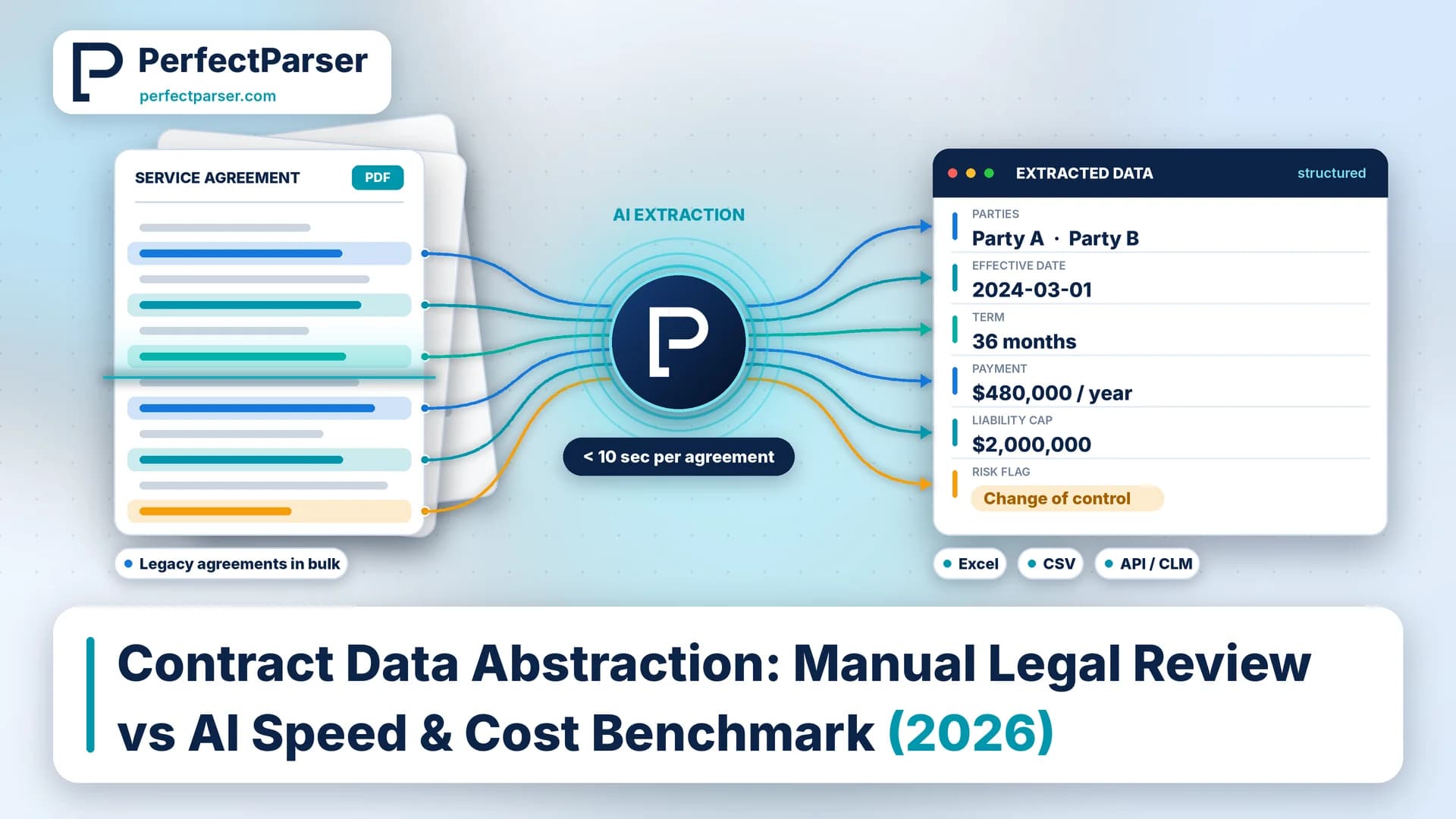
Quick summary: Manual contract data abstraction costs roughly $117 to $330 per agreement and takes 3 to 4 hours of skilled time, which makes large portfolios slow and expensive. Independent testing shows AI reviewing a contract in minutes at cents per document, and purpose-built tools like PerfectParser extract structured data in 2 to 5 minutes. This benchmark compares paralegal-led, attorney-led, outsourced, and AI approaches, then gives you the formulas to build a board-ready business case.
What Is Contract Data Abstraction, and Why Does Its Cost Matter to the Board?
Contract data abstraction pulls structured fields out of agreements and into a searchable record. Those fields include parties, effective and renewal dates, termination rights, payment obligations, liability caps, and risk clauses. It is the step underneath CLM migrations, M&A diligence, audits, and obligation tracking. Typical triggers include a CLM rollout, an acquisition, an audit, a renewal cycle, or a board request to quantify contract exposure.
The cost matters because you cannot manage terms you cannot see. World Commerce & Contracting finds that the average business loses almost 9% of value annually through poor contract management. Best performers lose about 3%, and the worst lose 15% or more. For a company with $200 million in revenue, each percentage point is $2 million. PerfectParser turns thousands of legacy agreements into structured data, so that value stops hiding in PDFs.
The True Cost of Manual Contract Data Abstraction: Attorney and Paralegal Labor Economics
Start with the cost of contract review by paralegals. The U.S. Bureau of Labor Statistics (OEWS, May 2025) reports a median of $62,890 a year for paralegals and legal assistants, about $30 an hour before benefits. We load that by 30% for benefits and overhead (our assumption, so adjust it), which gives roughly $39 an hour.
Practitioner guidance puts manual abstraction at 3 to 4 hours per contract. Paralegal-led abstraction therefore runs about $117 to $156 per contract.
Attorney-led review costs more. In the Onit study, Better Call GPT, senior lawyers averaged about 43 minutes per contract and juniors about 56. At a $350 blended rate, which is vendor-reported with outside counsel often at $300 to $500, that is $250 to $330 per contract.
Throughput is the bigger problem. The same practitioner source estimates that three paralegals abstracting full-time manage about 6 to 8 contracts a day. At that pace, a 5,000-contract backlog takes the team close to three working years. Inconsistent field definitions between reviewers and re-checking add further cost that rarely appears in the first estimate.
Contract Abstraction Services Cost: What LPO and Outsourcing Really Charge
Public price lists for legal process outsourcing are rare. Vendors usually quote per project, based on jurisdiction, language, and the number of fields to extract. The best independent data point is again the Onit study, which priced LPOs at $36.85 per document against about $75 for lawyers.
LPOs also scored highest on accuracy. The catch was time: they averaged about 201 minutes per contract, against 43 for senior lawyers.
That makes outsourcing a trade of cost for turnaround. Treat $36.85 as a floor, because the study covered issue review on ten procurement contracts. Full field-level abstraction, internal QA, and queueing behind a vendor's capacity will push both cost and elapsed time up. For a one-off project with a hard deadline, outsourcing can still make sense. For recurring volume, the per-contract cost and the turnaround compound. Before you sign, ask for turnaround guarantees on your actual volume, a defined error-correction process, and a clear price per additional field.
AI Contract Review: Speed, Accuracy, and Pricing Per Agreement
AI contract review has moved from experiment to benchmark. In the Onit study, the large language models reviewed a contract in roughly 2 to 5 minutes. Most averaged $0.25 or less per document. On accuracy, GPT-4 scored close to the LPOs and ahead of junior lawyers. That was early-2024 technology on ten contracts, so treat it as directional, not definitive.
Not all AI contract review tools do the same job. Some read a single agreement before signature and flag risks in plain English. Contract data abstraction is a portfolio problem: extracting the same structured fields from thousands of existing agreements, then exporting them to Excel, CSV, or your CLM. If your task is a backlog, a migration, or a diligence data room, choose software built for bulk abstraction.
Structured output is what makes abstraction useful downstream. A table of parties, dates, obligations, and clause flags can be filtered, audited, and loaded into a CLM. A paragraph of summary cannot.
Speed also changes what you can ask. A full-portfolio answer in hours instead of months lets you pose questions you would never fund manually, like how many agreements carry an auto-renewal or a change-of-control trigger.
PerfectParser is built for that job. It extracts structured metadata, financial obligations, and risk clauses in 2 to 5 minutes per agreement. Pricing is pennies per page, which keeps a typical agreement under $2. At 2 to 5 minutes each, a 5,000-agreement portfolio finishes in days rather than years, and results export to Excel, CSV, or CLM platforms via API.
Manual vs AI Contract Abstraction: Side-by-Side Cost and Speed Comparison
Modeled = our calculation from the wage and time inputs above. Measured = reported in the Onit study.
Read the table as a ladder where each step trades a different constraint. Manual methods are limited by headcount, outsourcing by turnaround, and AI by the quality of your exception process.
Contract Review Cost Benchmark: How the 2026 Numbers Break Down
A credible contract review cost benchmark separates what was measured from what was modeled:
- Measured: the Onit time and cost figures (43, 56, and 201 minutes; $75, $36.85, and $0.25 or less).
- Published wage data: the BLS paralegal median.
- Vendor-reported: attorney rates of $300 to $500 an hour and 3 to 4 hours per abstraction.
- Modeled: our 30% loading and the per-contract costs derived from it.
Complexity widens every range. A 40-page master services agreement with bespoke indemnities costs more to abstract than a standard NDA, whoever does it. Replace our assumptions with your own loaded rates, hours, and exception rates before taking numbers to the board, and keep the sources next to the figures so finance can verify them.
How to Calculate Contract Data Abstraction ROI (Formulas and a 5,000-Contract Example)
Executives need a repeatable formula, not just a headline number.
The formulas
- Manual cost = Volume × Hours per contract × Loaded hourly rate
- AI cost = (Volume × AI price per contract) + (Volume × Exception rate × Review hours × Attorney rate) + platform and implementation costs
- Net savings = Manual cost − AI cost
- Payback (months) = One-time costs ÷ Monthly net savings
The example: 5,000 contracts
- Manual: 3.5 hours × $39 = $136.50 per contract. 5,000 × $136.50 = $682,500 and 17,500 hours.
- AI extraction: 5,000 × $2 (a conservative ceiling) = $10,000.
- Exception review: 10% of contracts (500) get a 20-minute attorney check at $350 an hour, which is about $58,300 and 167 hours.
- AI total: about $68,300.
- Net savings: about $614,000, a 90% reduction.
Stress-test it: if the exception rate doubles to 20%, attorney review rises to about $116,700, total AI cost to about $126,700, and net savings are still about $556,000.
Break-even volume is the other number a CFO will ask for: One-time costs ÷ (Manual cost per contract − AI cost per contract). Here, AI costs about $13.67 per contract all-in, so each contract saves about $122.83. With a hypothetical $40,000 of one-time implementation cost, you break even at roughly 326 contracts.
This excludes platform fees and implementation, so enter your own. It also excludes recovered value, such as the renewals and obligations you would otherwise miss, which is where the 9% leakage figure applies. Want to test your own volume? Start with PerfectParser.
Where AI Contract Abstraction Pays Off Fastest: M&A Due Diligence, CLM Migration, and Legacy Backlogs
M&A due diligence. At 3.5 hours each, 5,000 target contracts is 17,500 review hours. A 20-person team needs about 22 full-time weeks, well beyond what most deal timelines allow. AI abstraction lets deal teams triage on day one by flagging change-of-control, assignment, exclusivity, and termination terms, so attorneys spend their hours on the agreements that matter.
CLM migration. A CLM platform is only as useful as the data loaded into it. Abstraction populates fields from legacy PDFs, and export to Excel, CSV, or API connections moves them in. Without it, migration means re-keying by hand, which is slow and invites errors. Clean, structured data at load also makes contract obligation tracking and renewal alerts work from day one.
Legacy backlogs and audits. Renewal dates, payment obligations, and liability caps buried in old agreements are where leakage hides. Bulk abstraction of the whole portfolio, not a sample, gives Legal Ops a complete picture for the first time, and a CFO a defensible baseline for the 9% leakage question.
How to Evaluate Contract Data Extraction Software: A Buyer’s Checklist
When comparing contract data extraction software, test these:
- Accuracy on your documents. Pilot 100 of your own agreements against a human-verified answer key.
- Field coverage. Check for structured metadata, financial obligations, and risk clauses, not just dates and party names.
- Throughput. Ask how long 5,000 agreements actually take, not how long one does.
- Security. Ask about encryption, access controls, data retention, and independent audit reports.
- Data handling. Confirm whether your contracts are used to train shared models, and where data is stored.
- Audit trail. Every extracted field should link back to its source clause so reviewers can verify it quickly.
- Export and integration. Look for Excel, CSV, and API connections to your CLM.
- Pricing transparency. Per-page pricing lets you forecast cost before you commit.
- Exception handling. Look for confidence flags that route uncertain fields to a human.
A simple pilot works well. Sample 100 agreements, build an answer key, run the extraction, and measure field-level accuracy and exception rate. Then price the full run with your measured exception rate instead of an assumed one.
PerfectParser is built around bulk abstraction, enterprise security, and direct export to Excel, CSV, or CLM platforms via API. Verify each point in your own pilot, with your own documents, before you commit.
Where Human Legal Review Still Wins (and Where PerfectParser Stops)
PerfectParser is not an automated legal advisor. It does not negotiate agreements or advise whether you should sign, and it does not replace human legal review on high-stakes litigation. Its job is to turn agreements into structured, searchable data quickly and consistently.
Human review wins where judgment dominates: negotiation strategy, bespoke risk allocation, regulatory interpretation, and anything heading to court. The Onit study also found that results depended on the model, so selection and testing matter. The practical answer is a hybrid:
- AI abstracts the full portfolio and flags low-confidence fields.
- Attorneys review exceptions, high-value contracts, and non-standard terms.
- Findings feed back into your playbook and your CLM.
In the example above, that is the 500 contracts worth a lawyer's time.
Benchmark AI Contract Abstraction on Your Agreements
Cut manual legal review costs by up to 90%. Extract party names, critical dates, financial obligations, and risk terms in 2–5 minutes with 20 free credits.
Try AI Contract Abstraction Free →