
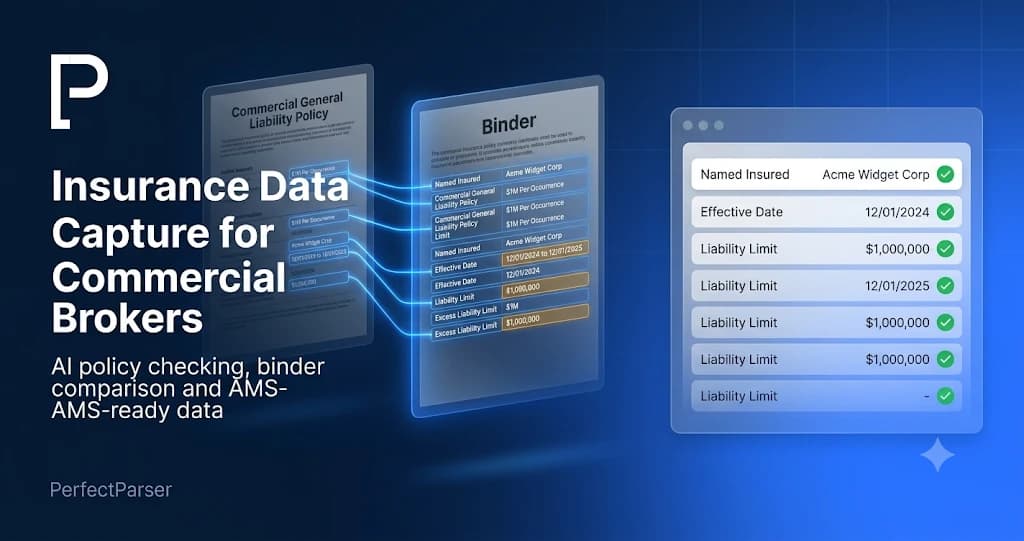
Every commercial policy that reaches your agency has to be read, keyed into your agency management system (AMS), and compared against what was quoted and bound. Done by hand, that work typically costs $80 per policy once you count staff time, and it still leaves room for missed endorsements and mismatched limits. Automated insurance data capture, such as PerfectParser's AI document extraction, reads the policy, extracts the key fields, compares them with the binder or quote, and flags differences for a person to review.
Commercial brokerage thrives on trust and technical precision. Yet an enormous fraction of agency payroll is spent on manual reading: opening 80-page carrier packets, re-typing coverage lines into AMS360 or Applied Epic, and meticulously comparing issued forms against bind requests.
This guide provides a transparent cost model for commercial policy intake, compares AI against offshore outsourcing and legacy template OCR, and details a 30-day pilot framework for commercial brokerages and MGAs.
What Is Insurance Data Capture?
Insurance data capture is the automated process of converting unstructured documents—including carrier declarations, policy schedules, endorsements, binders, and certificates—into structured records that flow directly into your system of record.
Historically, capture meant three distinct stages:
- Manual Keying: A CSR or account manager reads the document and retypes fields one by one.
- Template OCR: Software scrapes text from pre-defined bounding boxes on known carrier forms.
- AI-Based Extraction & Reconciliation: Large multimodal vision models read variable documents, understand policy semantics, and cross-reference values against binders.
Because commercial lines feature hundreds of specialized carrier layouts, the industry is transitioning rapidly to the third model. According to industry research in the Insurance Times Digital Adoption Report, modern brokerages increasingly cite legacy manual keying as their primary operational bottleneck.
Why Commercial Policy Checking Is Hard
Unlike personal auto or homeowners insurance, commercial lines policies lack standardized formatting. A single package policy may contain:
- Commercial General Liability (CGL)
- Commercial Property & Business Interruption
- Commercial Auto & Inland Marine
- Workers' Compensation & Employers Liability
- Umbrella / Excess Liability
A comprehensive policy check requires verifying:
- Named Insured Entities: Exact corporate names, DBAs, and mailing addresses.
- Term Chronology: Effective and expiration dates across multiple coverage parts.
- Limits & Deductibles: Per-occurrence, general aggregate, sub-limits, and percentage retentions.
- Endorsement Schedules: Tracking form numbers, edition dates, and exclusionary wording.
- Additional Interests: Additional insureds, loss payees, and waivers of subrogation.
- Financial Reconciliation: Premium, surcharges, inspection fees, and state taxes against quotes.
Missing any of these discrepancies can lead to unhedged client losses and catastrophic Errors and Omissions (E&O) claims. Agency intake teams must simultaneously audit incoming carrier policies and issue outgoing certificates; see how to automate ACORD form data extraction across forms 25, 28, and 125.
The Manual Workflow, Step by Step
Most commercial agencies run this operational sequence upon receiving an issued policy:
- Receive: Download the issued policy PDF from the carrier portal or email.
- Skim: Review declarations pages, policy schedules, and the attached forms checklist.
- Key into AMS: Manually transcribe policy numbers, premium, dates, and limits into AMS360 or Applied Epic.
- Retrieve Binder: Pull the original quote proposal and binder confirmation.
- Compare Line by Line: Cross-reference each limit, sub-limit, and endorsement line by line.
- Log Discrepancies: Record mismatches in a spreadsheet or internal note.
- Initiate Endorsement: Contact the carrier underwriter to request an endorsement correction.
- Finalize Client Package: Prepare client-facing executive summaries and file records.
Steps 3 and 5 represent over 70% of total processing time.
Manual Cost Benchmark: What Does It Cost to Check One Policy?
The benchmark figure of $80 per commercial policy reflects standard agency operational economics:
To calculate your own figure:
Cost per Policy = (Minutes Spent ÷ 60) × Loaded Hourly Rate + Average Rework Cost
When an agency processes 1,500 commercial policies annually, manual intake represents between $67,500 and $120,000 in direct labor costs, before accounting for unbilled rework.
The Costs That Never Show Up Per Policy
Direct labor is only the visible portion of manual processing:
- Rework & Correction Cycles: When an unrecorded endorsement requires an amended declaration, staff lose additional hours investigating carrier records.
- Intake Backlogs & Client Retention: Policy delivery delays during peak renewal quarters frustrate commercial clients and lenders.
- E&O Exposure: Missed exclusionary endorsements or incorrect sub-limits represent significant liabilities for brokerages.
Insurance Data Entry Services vs. AI: The Outsourcing Question
Agencies often consider offshore business process outsourcing (BPO) before adopting AI:
Outsourcing shifts the keystrokes but rarely eliminates the need for an in-house account manager to perform the legal comparison. Pairing AI document parsing with internal review eliminates double handling.
Insurance Data Entry Software: Three Generations Compared
PerfectParser utilizes Generation 3 AI extraction, reading policy schedules and declarations dynamically without per-carrier templates.
How AI Automates Commercial Insurance Policy Checking
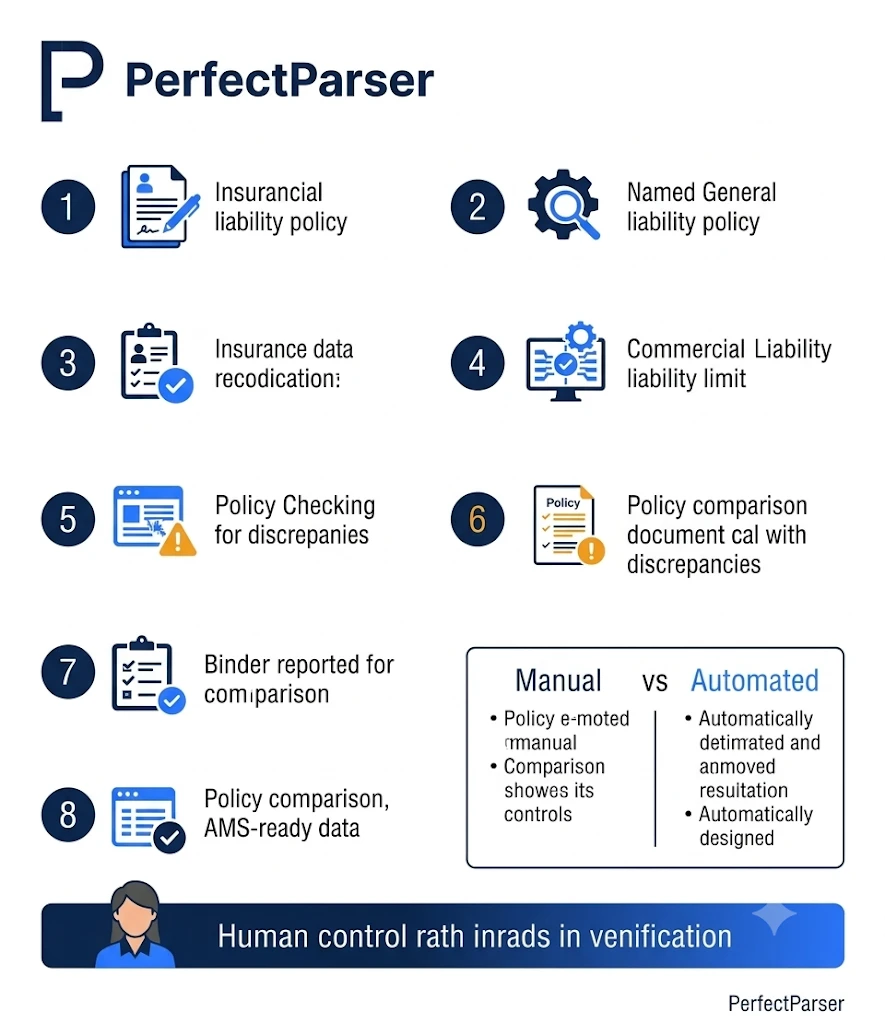
An automated policy checking pipeline executes eight sequential operations:
- Ingest: Policies, binders, and carrier quotes are ingested via email attachments, file drops, or API.
- Classify: AI distinguishes declarations, policy booklets, endorsements, and invoices.
- Extract: Coverage limits, deductibles, named insureds, and forms are parsed into structured data with source page tags.
- Normalize: Terminology across carriers (e.g., "Per Occurrence" vs. "Each Occurrence") is standardized.
- Compare: The issued policy data is programmatically matched against binder terms.
- Flag: Coverage differences, missing forms, and low-confidence readings are highlighted.
- Human Review: Licensed account managers verify flagged discrepancies with a side-by-side view.
- Export: Validated records are pushed directly into AMS360, Applied Epic, or internal data warehouses.
Insurance Policy Extraction: Which Fields Matter?
A comprehensive commercial insurance extraction schema captures five core categories:
- Declarations Data: Named insured legal entity, DBA, carrier name, policy number, term dates, and risk locations.
- Coverage Details: Per-occurrence limits, aggregate caps, deductibles, retentions, and coverage parts.
- Forms & Endorsements: Complete list of form numbers, edition dates, and title descriptions.
- Parties of Interest: Additional insureds, certificate holders, loss payees, and mortgagees.
- Financial Breakdown: Base premiums, terrorism risk premiums, state surcharges, and total cost.
For a detailed review of policy schedule mechanics, see our technical breakdown of how an AI insurance policy schedule parser extracts limits and endorsements.
Automate Insurance Binder Review: Pre-Bind vs. Post-Issuance
The highest-leverage feature of automated intake is side-by-side binder review:
- Limit Reductions: Alerting when an issued policy carries a $1,000,000 sub-limit where $2,000,000 was bound.
- Missing Endorsements: Identifying endorsements agreed in quotes but omitted from the carrier's forms schedule.
- Entity Inconsistencies: Detecting dropped corporate suffixes (e.g., "LLC" vs. "Inc.") in named insured schedules.
- Deductible Mismatches: Highlighting higher hurricane or earthquake deductibles than quoted.
Surface errors at delivery—when corrections are routine—rather than during claim litigation. Catching discrepancies between proposals and policies mirrors the compliance review required in contract data extraction when comparing master agreements against executed schedules.
AMS360 and Applied Epic: Getting Clean Data Into Your System
Automated extraction delivers maximum value when integrated into your agency management software:
- AMS360 Integration: Populate policy lines, coverages, and driver/location schedules via API or structured CSV imports.
- Applied Epic Integration: Map extracted policy records directly into client accounts and activity tasks. As highlighted in Applied Systems broker automation analyses, modern API-driven data ingest prevents duplicate entry between carrier files and core agency ledgers.
Conducting a one-time mapping review during initial setup ensures carrier codes map smoothly to your agency's account structure.
Keeping Humans in the Loop
Automated capture enhances broker operations while preserving licensed oversight:
- What Technology Does: Parses documents, structures tabular data, flags discrepancies, and automates data delivery.
- What Your Team Does: Applies coverage analysis, advises commercial clients, coordinates carrier endorsements, and authorizes changes.
- Liability Stays Professional: Technology tools do not bind risks, issue coverage opinions, or assume brokerage E&O responsibility.
Building the ROI Case
To evaluate the economic rationale for your agency:
Annual Manual Cost = Policies per Year × Manual Cost per Policy
Annual Automated Cost = Policies per Year × (Platform Fee per Policy + Review Time × Loaded Rate)
Illustrative Agency Economics (1,500 Commercial Policies / Year)
Beyond direct dollar savings, eliminating 45 minutes of manual retyping per policy grants your account managers capacity to service higher-margin accounts.
A 30-Day Pilot Plan
Implement automated policy checking systematically:
- Week 1 (Baseline): Time 25 to 50 recent policies by hand. Measure minutes per policy, discrepancies caught, and rework cycles.
- Week 2 (Configure): Define target fields, configure AMS mapping, and establish review thresholds in PerfectParser.
- Week 3 (Parallel Run): Process incoming commercial policies through both manual and automated pipelines simultaneously.
- Week 4 (Evaluation): Compare speed, discrepancy capture rates, and staff feedback to validate expansion.
Automate Commercial Insurance Policy Checking & Data Capture
Eliminate manual AMS keying and catch binder discrepancies instantly. Extract limits, deductibles, endorsements, and schedules from commercial carrier policies into clean structured data. 20 free pages included.
Start Extracting Policies Free →