
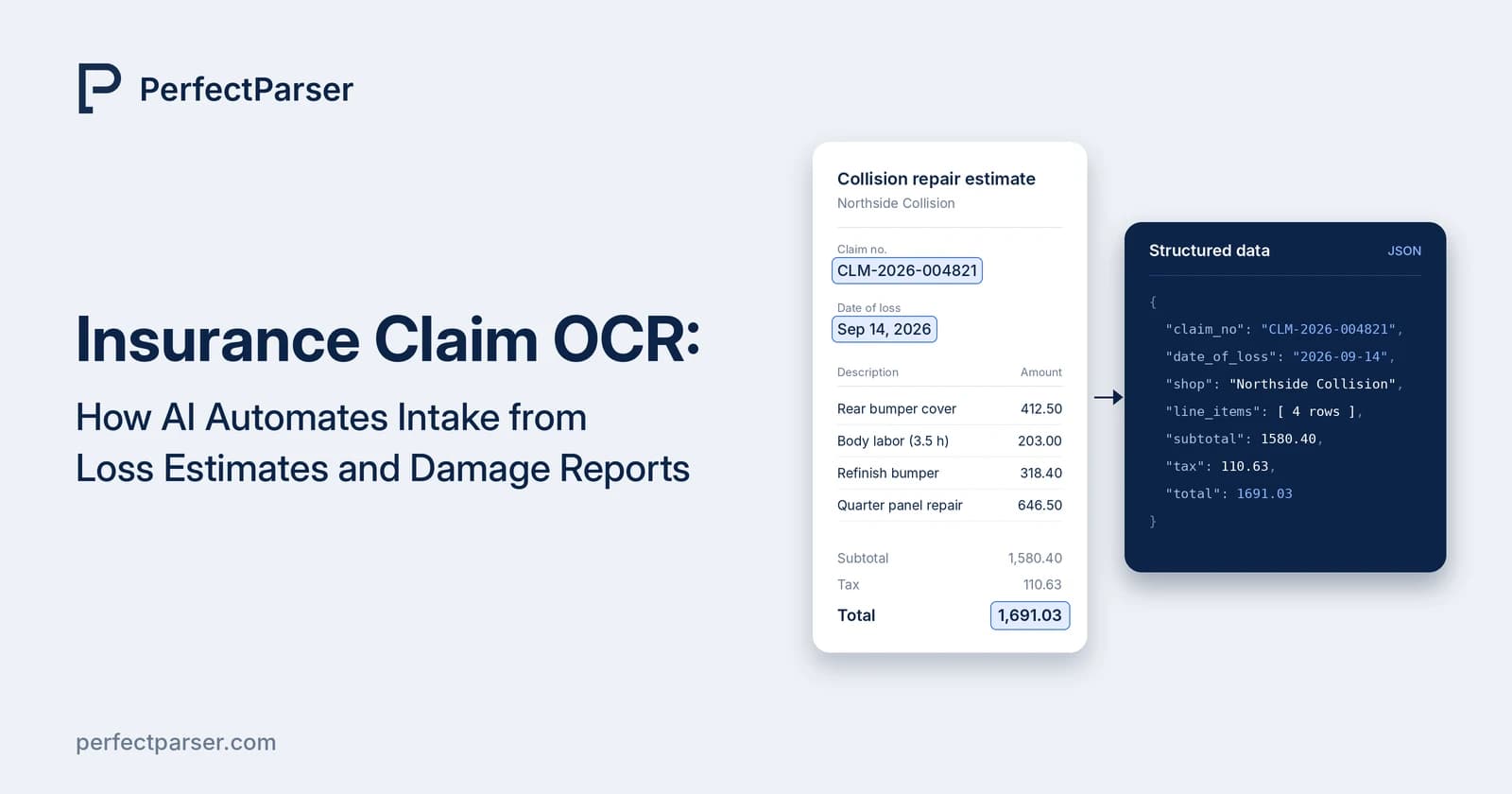
Insurance claim OCR turns repair estimates, contractor invoices, medical bills, and adjuster reports into structured data your claims system can use. Plain OCR extracts words; AI extraction reads the document in context, captures complex line-item tables, and lets adjusters focus on decisions instead of retyping. Tools like PerfectParser deliver structured outputs via API, Excel, or JSON without fragile template maintenance.
Decisions are rarely the bottleneck in insurance claims processing. Documents are. Estimates arrive from hundreds of body shops and contractors, each formatting labor, parts, paint, and sublet items differently. Reports arrive as email attachments, portal uploads, faxes, and mobile phone photos. Before an adjuster can review coverage or authorize repairs, someone must rekey the numbers into core systems.
That delay shows up directly in loss adjustment expenses (LAE) and cycle times. Independent benchmarks from the J.D. Power U.S. Auto Claims Satisfaction Study indicate the average auto physical damage claim takes nearly 19.3 days to resolve. When policyholders expect real-time mobile updates, manual document intake creates needless friction.
What Insurance Claim OCR Does, and Where Plain OCR Stops
Optical character recognition converts pixels into machine-readable characters. What it cannot do is understand document semantics. A single collision estimate page often contains the date "03/14/2026" three times: as the incident date of loss, the inspection date, and the shop printing date. Plain OCR cannot determine which date is which.
Template-based OCR attempts to solve this by drawing fixed bounding boxes on a page. That approach collapses when an independent appraiser uses CCC ONE, a second uses Mitchell, and a third sends an Audatex or manual spreadsheet estimate.
AI extraction operates differently:
- Semantic understanding: The vision model identifies fields by contextual meaning and proximity rather than fixed XY coordinates.
- Table reconstruction: Multi-page parts and labor grids are parsed into structured arrays with line-level operations (replace, repair, refinish).
- Flexible configuration: In PerfectParser, you describe what you need in plain English—such as "extract claim number, claimant, vehicle VIN, parts table, labor hours, and grand total"—and the system autodetects the fields immediately.
Motor Insurance Claim OCR: Collision Repair Estimates
Collision estimates represent the highest volume and greatest complexity in physical damage intake. A typical estimate consists of three distinct zones:
The line-item table is where traditional OCR breaks. PerfectParser's smart table extraction preserves multi-line descriptions and parent-child groupings across page breaks, returning a single normalized row per line item.
Insurance Estimate PDF Parser: Contractor and Property Estimates
Property claims rely heavily on contractor estimates and scope-of-loss reports from Xactimate or Symbility. An insurance estimate PDF parser must extract:
- Claim number and named insured
- Property risk address
- Date of loss and inspection date
- General contractor name, tax ID, and contact details
- Itemized scope by room (demolition, drywall, painting, electrical)
- Material vs. labor cost breakdown, overhead, profit, and depreciation
Because property estimates often span 20 to 50 pages, automating scope extraction lets field adjusters and examiners compare contractor estimates against staff guidelines in minutes rather than hours. Before reimbursing contractor scopes, examiners cross-check line-item totals against the policy's deductible and sub-limits extracted via an insurance policy schedule parser.
Health Insurance Claim OCR: Medical Bills and Claim Forms
For injury and healthcare claims, intake systems must ingest standard US healthcare billing forms:
- CMS-1500: Professional claims from physicians, physical therapists, and clinics defined under CMS.gov standards.
- UB-04 (CMS-1450): Institutional claims from hospitals and surgical centers.
Standard fields extracted from these documents include:
- Patient legal name, date of birth, and member ID
- Billing provider name, address, and National Provider Identifier (NPI)
- Dates of service (from/through)
- ICD-10 diagnosis codes and CPT/HCPCS procedure codes
- Itemized charges, units, and total claimed amount
Note: Automated extraction captures document data accurately. It does not determine medical necessity or make coverage decisions.
Claim Assessment Report Data Extractor: Adjuster Narratives and Loss Reports
Independent adjuster (IA) narrative reports combine structured metadata with narrative paragraphs. A robust claim assessment extractor captures:
- Claim number and policyholder details
- Incident date, time, and precise loss location
- Stated cause of loss (wind, water, theft, collision)
- Initial reserves and estimated gross loss figures
- Key narrative summaries (e.g., initial subrogation potential or fraud flags)
Data Extraction for Claims: A TPA Workflow
Third-Party Administrators (TPAs) face the greatest operational challenge because they handle disparate carrier guidelines and systems simultaneously. A repeatable intake workflow follows five steps:
- Intake: Ingest files continuously via incoming email webhooks, secure SFTP, or API uploads.
- Document Routing: Direct each file to its dedicated parser (collision estimate, property estimate, medical bill, or ACORD notice of loss).
- Bulk Parallel Extraction: Process dozens of multi-page packets concurrently.
- Validation: Execute automatic business logic checks before queuing to core claims software.
- Exception Review: Route only documents with discrepancies or low-confidence scores to a human adjuster.
Third-Party Administrators handling intake across multiple markets face similar unit economics to brokerage policy checking; see our analysis of manual vs. automated insurance data capture costs.
Getting Data Into Guidewire, Duck Creek, and Other Claims Platforms
PerfectParser acts as an intelligent ingestion layer. Through standard REST APIs and outbound webhooks, extracted JSON data is posted directly to your integration middleware (e.g., MuleSoft, Zapier, AWS Lambda), which maps fields into:
- Guidewire ClaimCenter
- Duck Creek Claims
- Applied Systems / AMS360
- Salesforce Financial Services Cloud
Teams that aren’t ready for an API integration can start with Excel or CSV exports and move to webhooks later. Furthermore, when property losses trigger new liability certifications or binder renewals, TPAs often ingest both loss runs and incoming ACORD certificates through the same API pipeline.
What the Extracted Output Looks Like
Below is an illustrative JSON payload for an auto physical damage estimate:
{
  "claim_number": "CLM-2026-004821",
  "claimant_name": "Jordan Ellis",
  "date_of_loss": "2026-09-14",
  "vehicle": {
    "year": 2021,
    "make": "Honda",
    "model": "Civic",
    "vin": "1HGCR2F83MA019284"
  },
  "repair_facility": {
    "name": "Northside Collision Center",
    "tax_id": "XX-XXXXXXX"
  },
  "line_items": [
    {
      "operation": "Replace",
      "type": "Part",
      "description": "Rear bumper cover OEM",
      "part_number": "04711-TBA-A90ZZ",
      "quantity": 1,
      "unit_price": 412.50
    },
    {
      "operation": "Labor",
      "type": "Body",
      "description": "R&I rear bumper assembly",
      "hours": 3.5,
      "rate": 58.00
    }
  ],
  "subtotal": 2180.40,
  "tax": 152.63,
  "deductible": 500.00,
  "net_claim_total": 1833.03
}
Validate Before You Post to the Claims System
Never feed extracted data blindly into production ledgers. Enforce validation rules during ingestion:
- Mathematical Reconciliation: Line items must sum to subtotals, and subtotal + tax − deductible must equal net total.
- Claim Number Matching: Verified against active, open claims in your system of record.
- Date Boundary Checks: Date of loss must fall between policy effective and expiration dates.
- VIN Validation: Ensure VIN conforms to the standard 17-character alphanumeric format.
- Duplicate Detection: Flag duplicate invoice numbers or identical repair estimates.
Setting It Up in PerfectParser
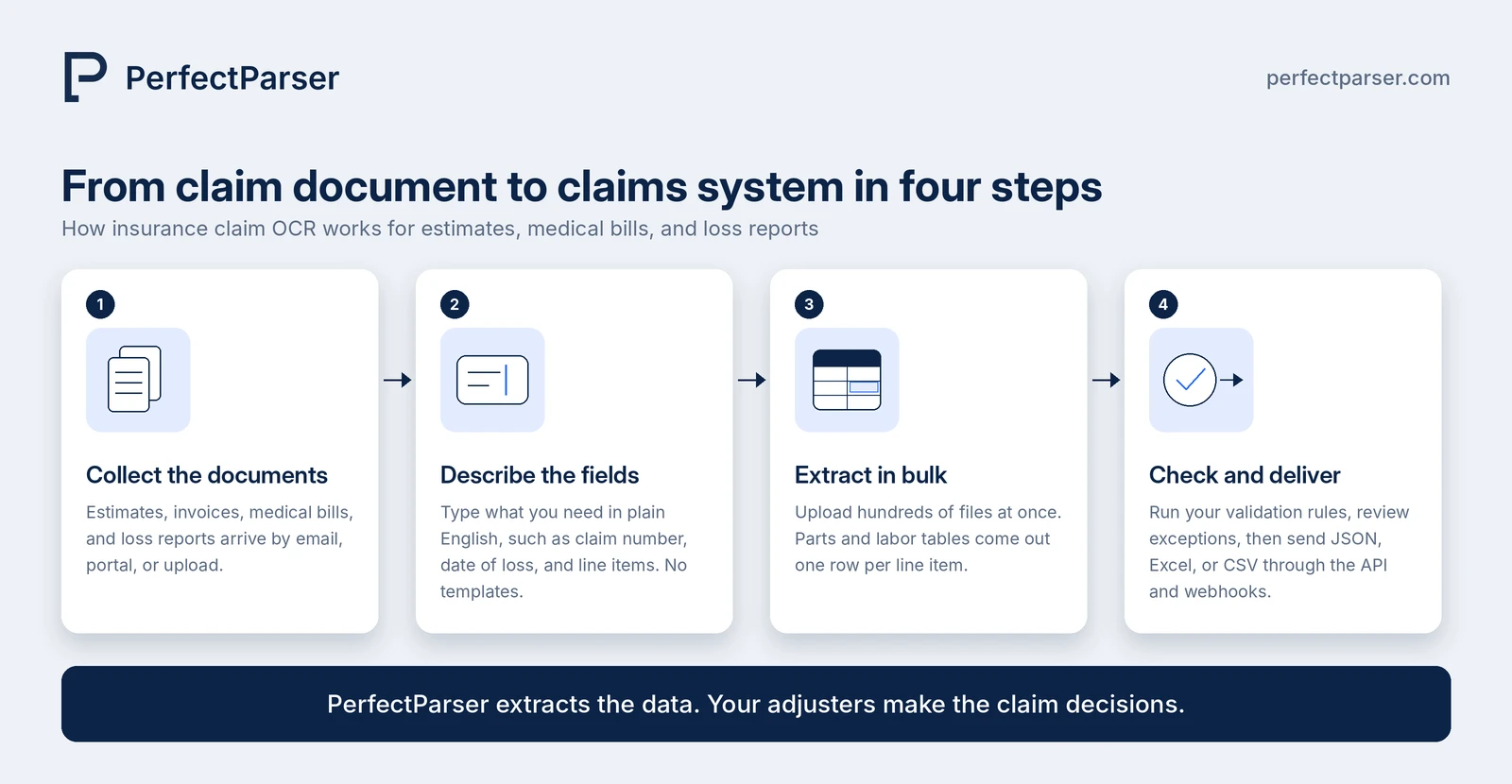
Deploying an insurance claim extraction workflow requires just minutes:
- Sign Up: Create an account to receive 20 free trial pages with zero commitment.
- Upload a Sample Estimate: Upload a representative PDF or scan of your estimate or medical bill.
- Define Fields: Describe the target fields using natural language prompts.
- Save and Process: Name your parser and process incoming claims in bulk via the dashboard or REST API.
Automate Insurance Claim Estimate Intake with AI OCR
Extract parts, labor, codes, and totals from collision estimates, property scopes, and medical bills into clean JSON, Excel, or your claims management system. 20 free pages included.
Start Extracting Claim Documents Free →