
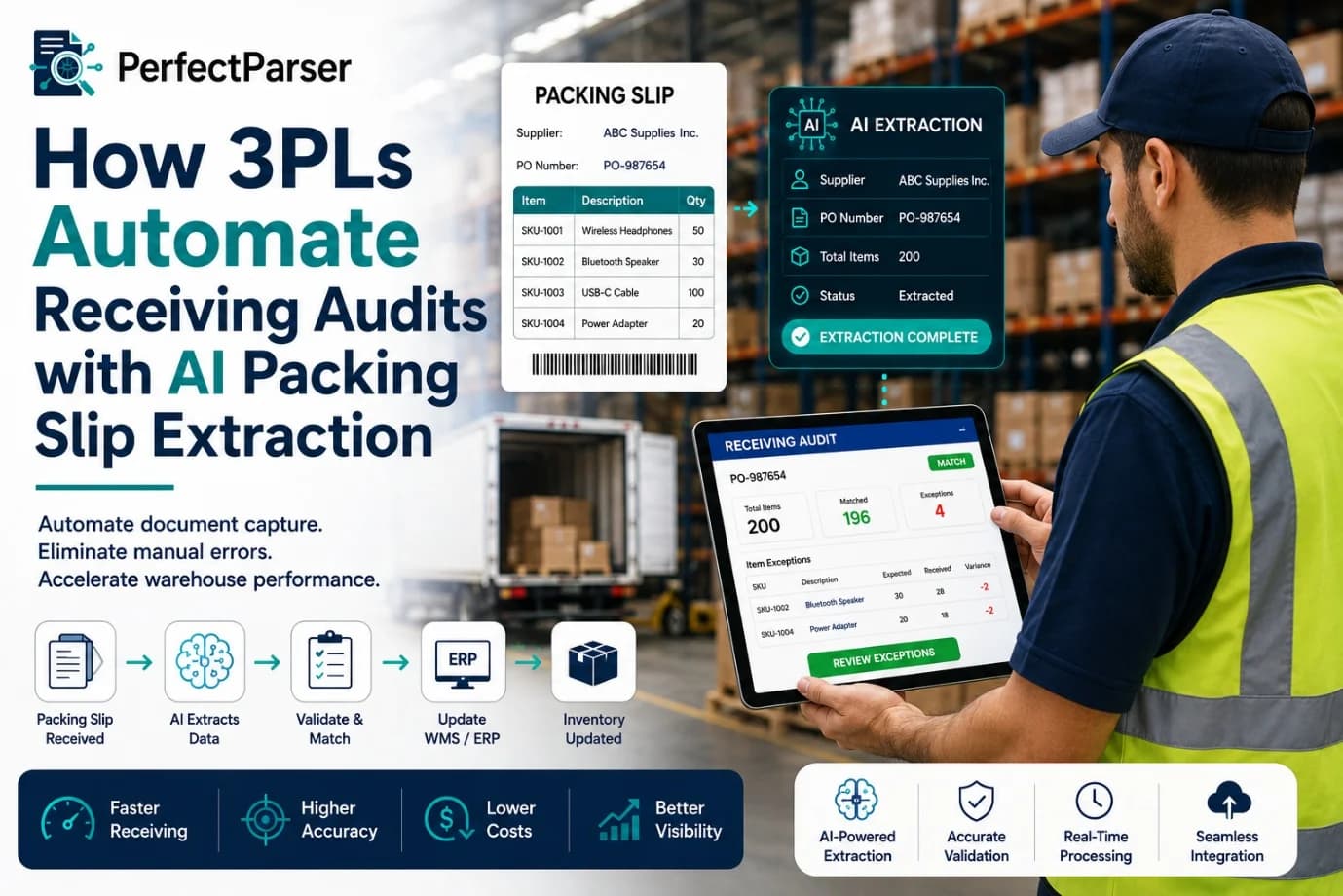
Warehouse receiving is one of the most important stages in the logistics process. Every shipment that enters a distribution center must be verified against purchase orders, inventory records, and shipping documents before products move to storage or outbound fulfillment. For third-party logistics providers (3PLs), even a small receiving error can create inventory discrepancies, delayed shipments, customer complaints, and unnecessary operational costs.
Many warehouses still rely on manual document checks, where employees compare paper packing slips with physical shipments and warehouse management systems. While this process works for low volumes, it becomes difficult to maintain speed and accuracy as order volumes grow.
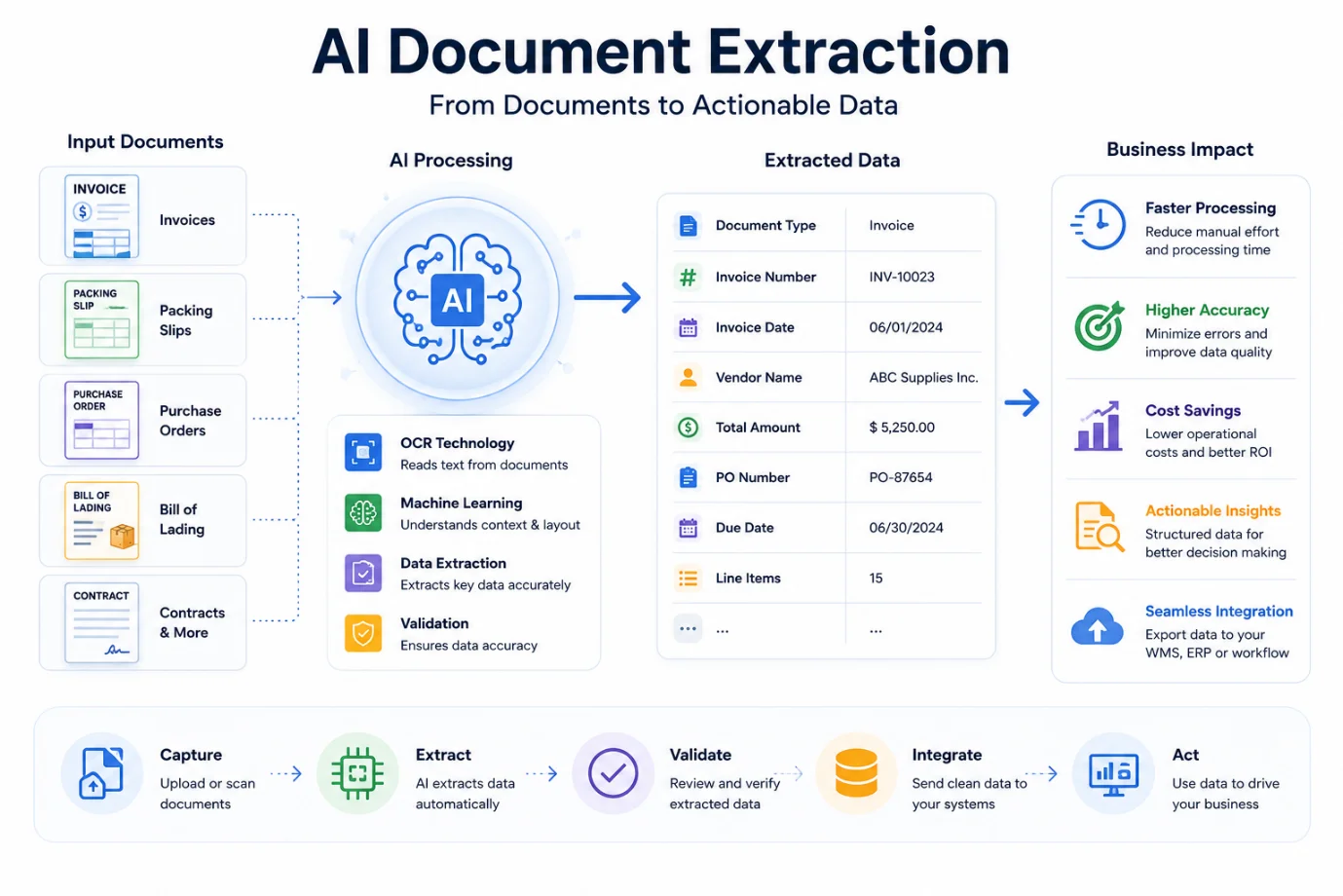
This is where AI Packing Slip Extraction changes the process. Instead of manually entering document information, AI automatically captures, understands, and validates shipment details within seconds. Warehouse teams receive structured data that is ready for verification, helping them identify mismatches before they affect inventory accuracy.
In this guide, you'll learn how modern receiving audits work, why automation matters for 3PL operations, practical implementation tips, common mistakes to avoid, and how AI improves warehouse efficiency without disrupting existing workflows.
Why Receiving Accuracy Matters
Receiving audits are the first quality checkpoint inside any warehouse. Their purpose is simple: confirm that the shipment arriving at the dock matches what was ordered and what the supplier claims was shipped.
A standard receiving audit verifies:
- Supplier information
- Purchase order numbers
- Product SKUs
- Item descriptions
- Quantities received
- Missing products
- Damaged inventory
- Batch or lot numbers
- Shipping references
When these details are reviewed accurately, inventory records remain reliable throughout the supply chain.
However, manual verification creates several operational challenges.
Common Problems During Manual Audits
Warehouse teams frequently experience:
- Slow document processing
- Human typing errors
- Missing shipment information
- Duplicate data entry
- Delayed inventory updates
- Longer truck unloading times
- Higher labor costs
As shipment volume increases, these problems multiply. Teams often spend more time entering data than inspecting incoming goods. To measure the financial payoff of eliminating manual entry at scale, review our automated packing slip extraction ROI analysis.
How Intelligent Automation Improves the Process
Modern warehouses no longer depend entirely on manual document reviews.
Instead, intelligent software extracts shipment information automatically before warehouse staff begin verification. This allows employees to focus on exceptions instead of repetitive administrative work.
For example, packing slip data extraction automatically identifies important shipment fields from supplier documents and converts them into structured digital records. Instead of searching through paperwork, receiving teams immediately view standardized information ready for comparison.
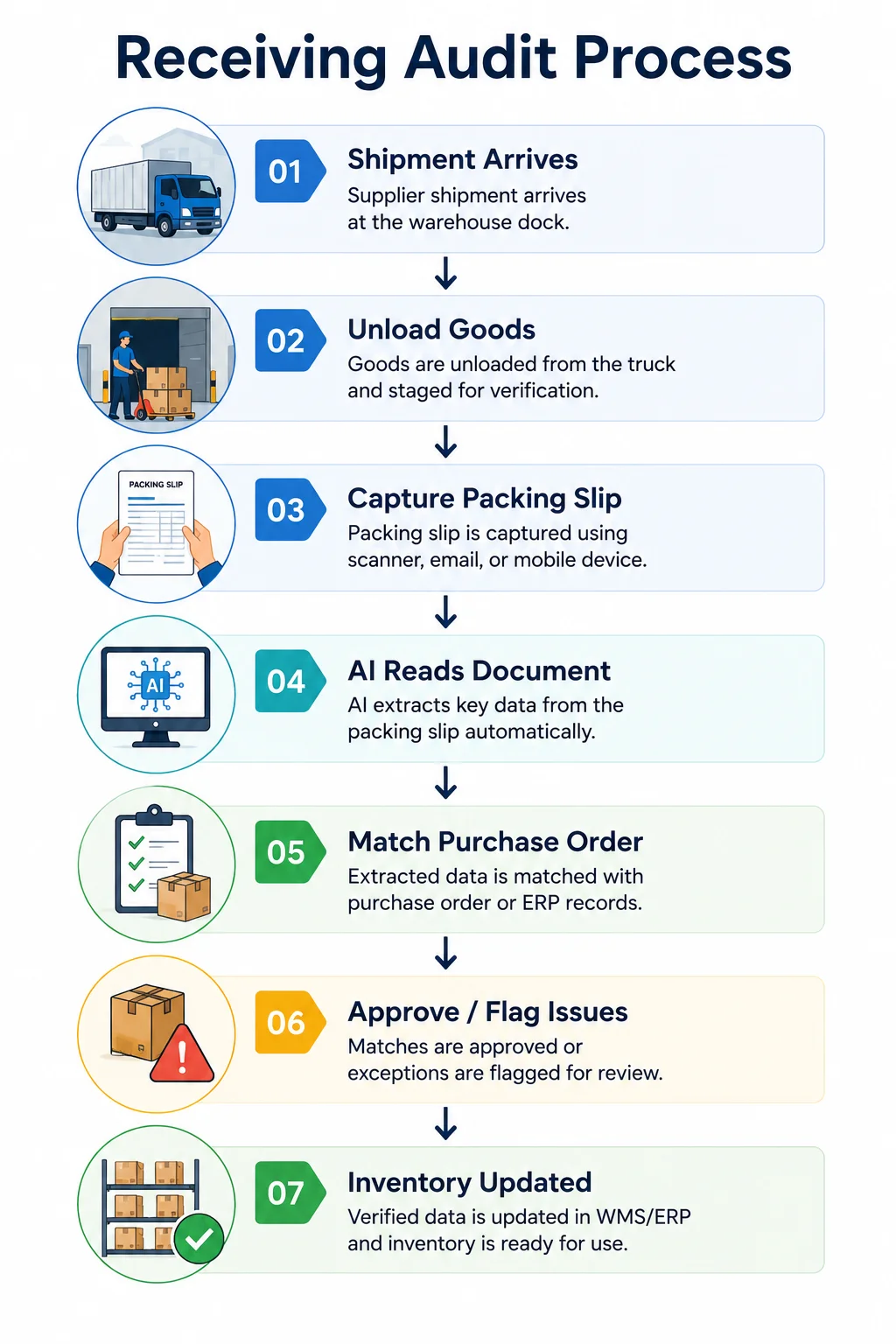
The process typically follows these steps:
This workflow reduces repetitive work while improving consistency across every shipment.
Building a Faster Receiving Workflow
Warehouse operations become more efficient when repetitive administrative tasks are removed from the receiving dock.
Instead of assigning multiple employees to document verification, businesses can automate information capture and allow experienced workers to investigate only exceptions.
A typical intelligent workflow includes:
- Shipment arrives.
- Documents are uploaded automatically.
- Important fields are captured using AI document extraction
- Information is compared against purchase orders.
- Quantity differences are highlighted.
- Warehouse staff confirm physical inventory.
- Inventory records are updated.
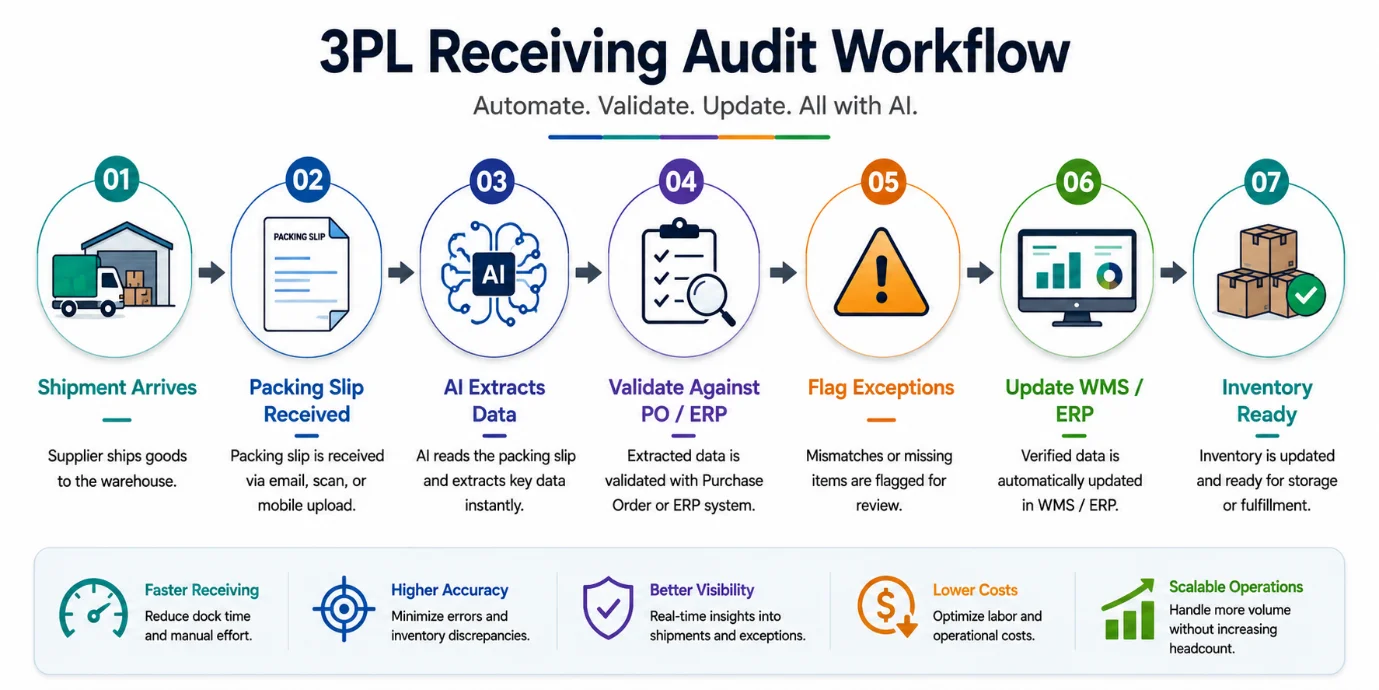
This approach shortens receiving cycles while improving overall inventory visibility.
Practical Example
Imagine a regional distribution center receiving 250 deliveries every day.
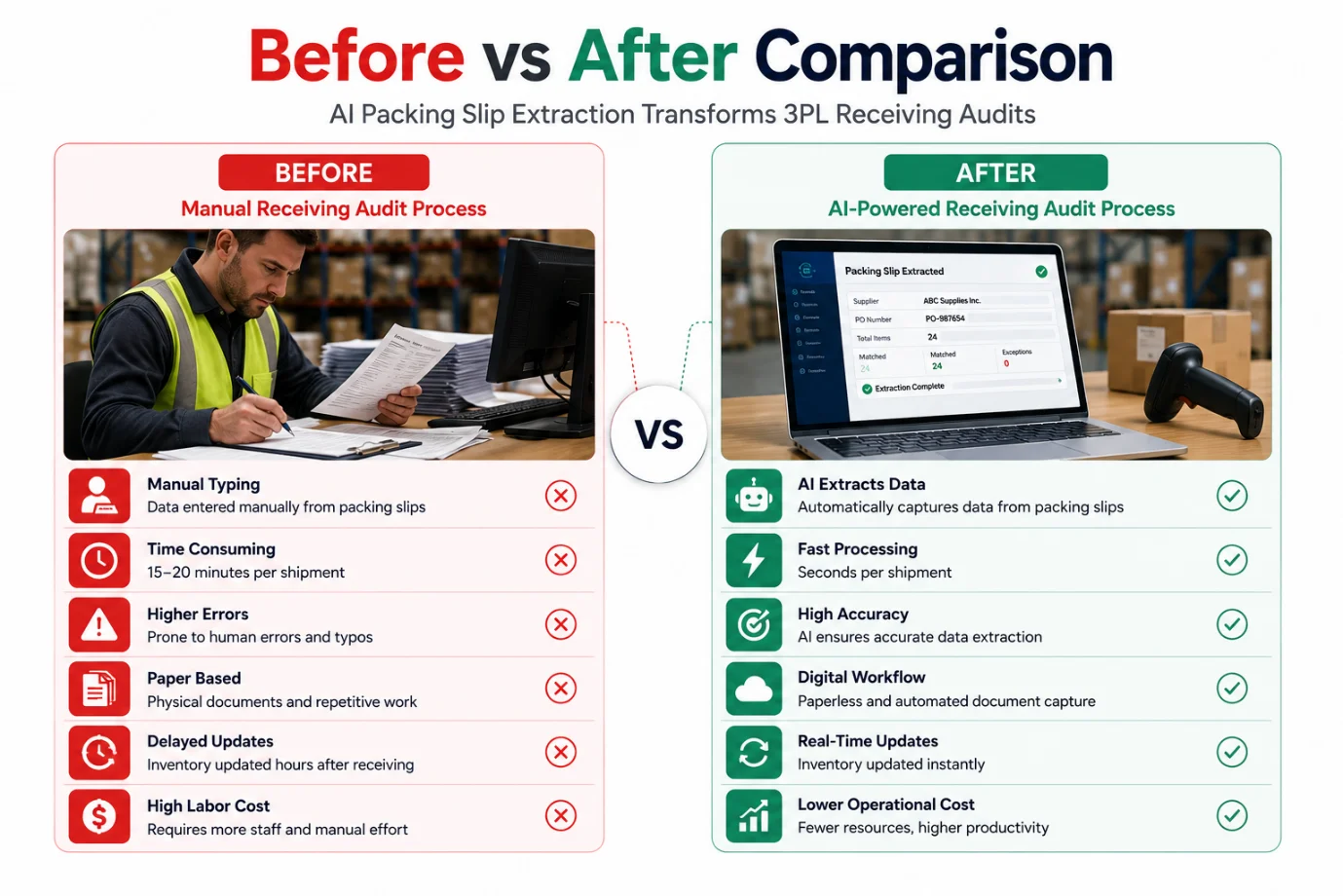
Without automation:
- Employees manually review every packing slip.
- Data is typed into warehouse software.
- Inventory updates may take hours.
- Mistakes require additional investigation.
With automated processing:
- Documents are captured immediately.
- Shipment information appears within seconds.
- Staff only review flagged exceptions.
- Inventory updates occur much faster.
The result is a smoother receiving operation without increasing staffing levels.
Improving Accuracy Without Slowing Operations
Speed is valuable, but accuracy has an even greater impact on warehouse performance.
Incorrect inventory records can create problems throughout the supply chain, including:
- Stock shortages
- Incorrect replenishment
- Delayed customer orders
- Billing disputes
- Higher operational costs
Modern systems reduce these risks by validating extracted information before inventory is updated.
For example, packing slip OCR converts printed shipment documents into machine-readable text, allowing warehouse software to interpret supplier documents more accurately than manual typing. Employees can then review highlighted exceptions instead of searching through every line item.
This creates a balanced workflow where automation handles repetitive tasks while experienced warehouse staff make final business decisions.
Best Practices for Successful Implementation
Organizations often achieve better results when automation is introduced gradually rather than replacing every manual process at once.
Successful projects usually include:
- Standardizing supplier document formats whenever possible.
- Validating extracted information before updating inventory.
- Training warehouse teams on reviewing exceptions.
- Measuring receiving accuracy before and after implementation.
- Monitoring continuous performance improvements.
- Integrating automation with existing warehouse systems instead of replacing them entirely.
These practices help teams build confidence while maintaining operational continuity.
Strengthening Warehouse Performance Over Time
Technology alone does not guarantee better receiving audits. The greatest improvements come from combining automation with well-defined warehouse processes and continuous performance monitoring.
Once shipment data is captured automatically, managers gain access to insights that are difficult to obtain through manual workflows. They can identify recurring supplier issues, track receiving performance, and measure operational efficiency using consistent data.
Useful metrics include:
Monitoring these KPIs enables warehouse managers to make informed decisions, allocate resources effectively, and improve receiving operations over time.
Supporting Growing Logistics Operations
Seasonal demand, multiple suppliers, international shipments, and higher order volumes all place additional pressure on receiving teams. When managing inbound containerized freight alongside local parcel receiving, see how teams automate Bill of Lading data entry for freight forwarders and 3PLs.
Rather than hiring more staff for repetitive document handling, many logistics providers focus on smarter workflows that can scale alongside business growth.
For example, AI packing slip processing enables warehouses to handle large volumes of shipment documents consistently without significantly increasing manual effort. Staff members spend less time entering information and more time resolving exceptions, inspecting goods, and ensuring inventory quality.
This approach is particularly valuable for organizations managing multiple warehouse locations, where standardized receiving procedures help maintain consistent operational performance across facilities.
A Practical Example
Consider a 3PL warehouse that receives products from dozens of suppliers every day.
Previously, receiving clerks manually entered shipment details into the warehouse management system before inventory could be updated. During busy periods, document backlogs delayed receiving, trucks waited longer at unloading docks, and inventory records were sometimes updated hours after physical goods had already been stored.
After introducing automated document capture:
- Shipment documents are processed immediately after arrival.
- Warehouse teams review only flagged discrepancies.
- Inventory updates happen much faster.
- Managers gain real-time visibility into receiving activities.
- Dock congestion decreases during peak periods.
The result is a smoother workflow that benefits warehouse staff, suppliers, and customers alike.
Common Mistakes to Avoid
Automation delivers the best results when it complements existing warehouse processes rather than replacing good operational practices.
Avoid these common mistakes:
- Expecting Immediate Perfection: No automated system is flawless from day one. Initial testing, validation, and adjustments help improve long-term accuracy.
- Ignoring Document Quality: Poor-quality scans, damaged paperwork, or handwritten notes can affect extraction results. Clear digital documents improve reliability.
- Skipping Human Review: Automation should identify exceptions—not eliminate oversight. Employees should continue reviewing unusual shipments, damaged goods, or quantity mismatches.
- Failing to Measure Performance: Without tracking key metrics, it becomes difficult to evaluate whether receiving efficiency has actually improved.
- Overlooking Employee Training: Warehouse teams should understand how automated workflows operate so they can confidently review exceptions and resolve discrepancies.
Looking Ahead
Receiving audits are becoming more data-driven as warehouses continue adopting digital technologies. Future improvements will likely focus on deeper integration between warehouse management systems, transportation platforms, and supplier networks.
The goal is not simply to reduce manual work but to improve visibility throughout the receiving process. Faster access to reliable shipment information allows organizations to respond more quickly to inventory issues, supplier discrepancies, and customer demands.
As these technologies mature, logistics providers will be better equipped to maintain operational accuracy while supporting growing shipment volumes.
Conclusion
Efficient receiving audits are essential for maintaining accurate inventory, reducing operational delays, and improving customer satisfaction. By replacing repetitive document entry with intelligent automation, warehouses can process incoming shipments more consistently while allowing employees to focus on inspection and exception handling.
Organizations investing in 3PL automation are finding that better data quality leads to faster receiving, improved inventory visibility, and stronger operational control. Whether managing a single warehouse or a nationwide distribution network, modern receiving workflows help build a more reliable and scalable supply chain.
If your organization is looking to improve receiving accuracy and streamline warehouse operations, now is the ideal time to evaluate how intelligent document automation can support your long-term logistics strategy.
Try PerfectParser Free
Extract data from your first documents today. No credit card required — 20 free credits included.
Start Extracting →