
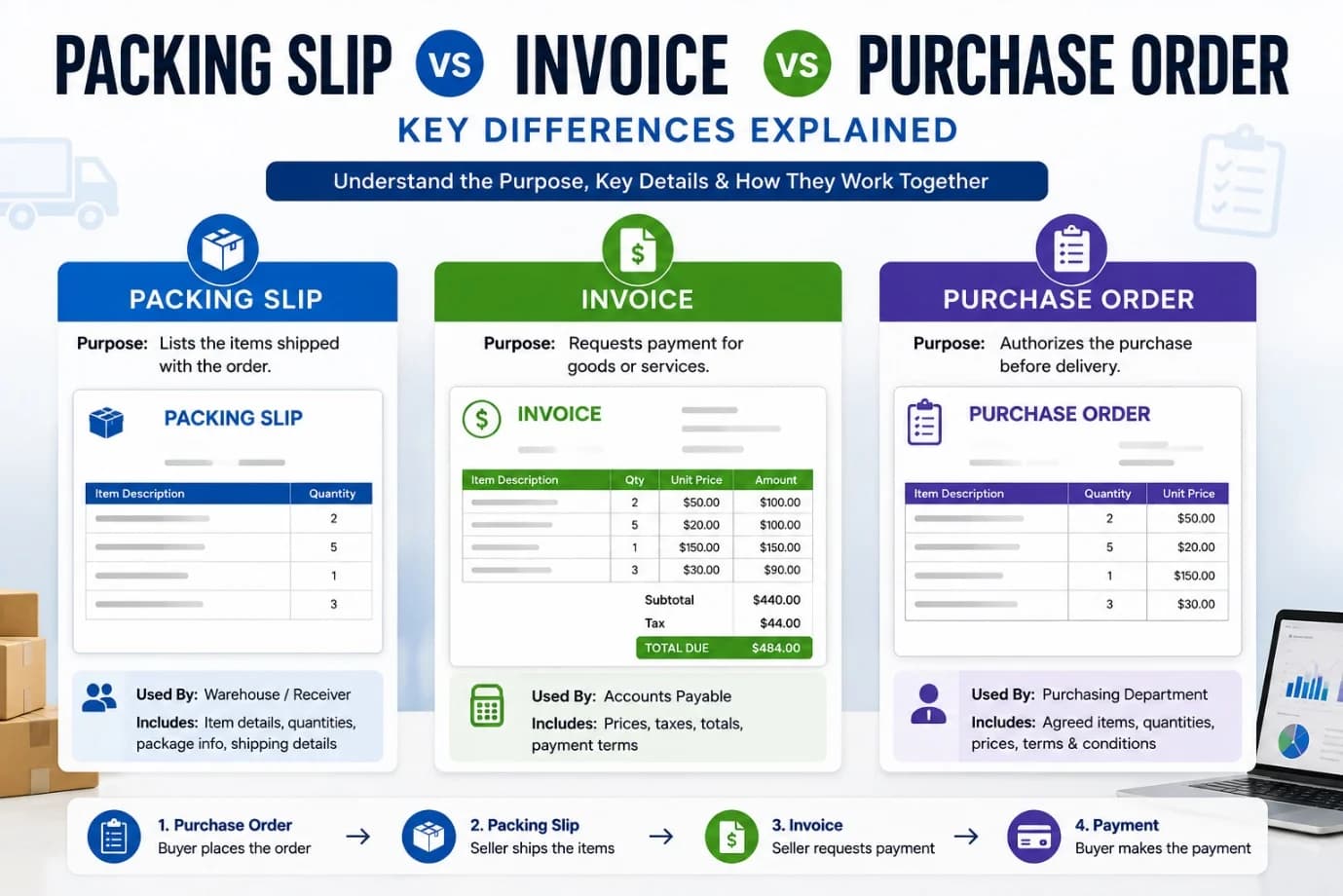
Managing business documents becomes much easier when you understand the purpose of each record used in the buying and shipping process. Many business owners, warehouse teams, and procurement professionals confuse shipping documents with billing documents, leading to delayed payments, incorrect deliveries, or accounting errors.
This guide explains the Packing Slip vs Invoice vs Purchase Order comparison in simple terms. You'll learn when each document is created, who uses it, what information it contains, and how they work together throughout the purchasing cycle. By the end, you'll know exactly which document serves which purpose and how to avoid common mistakes.
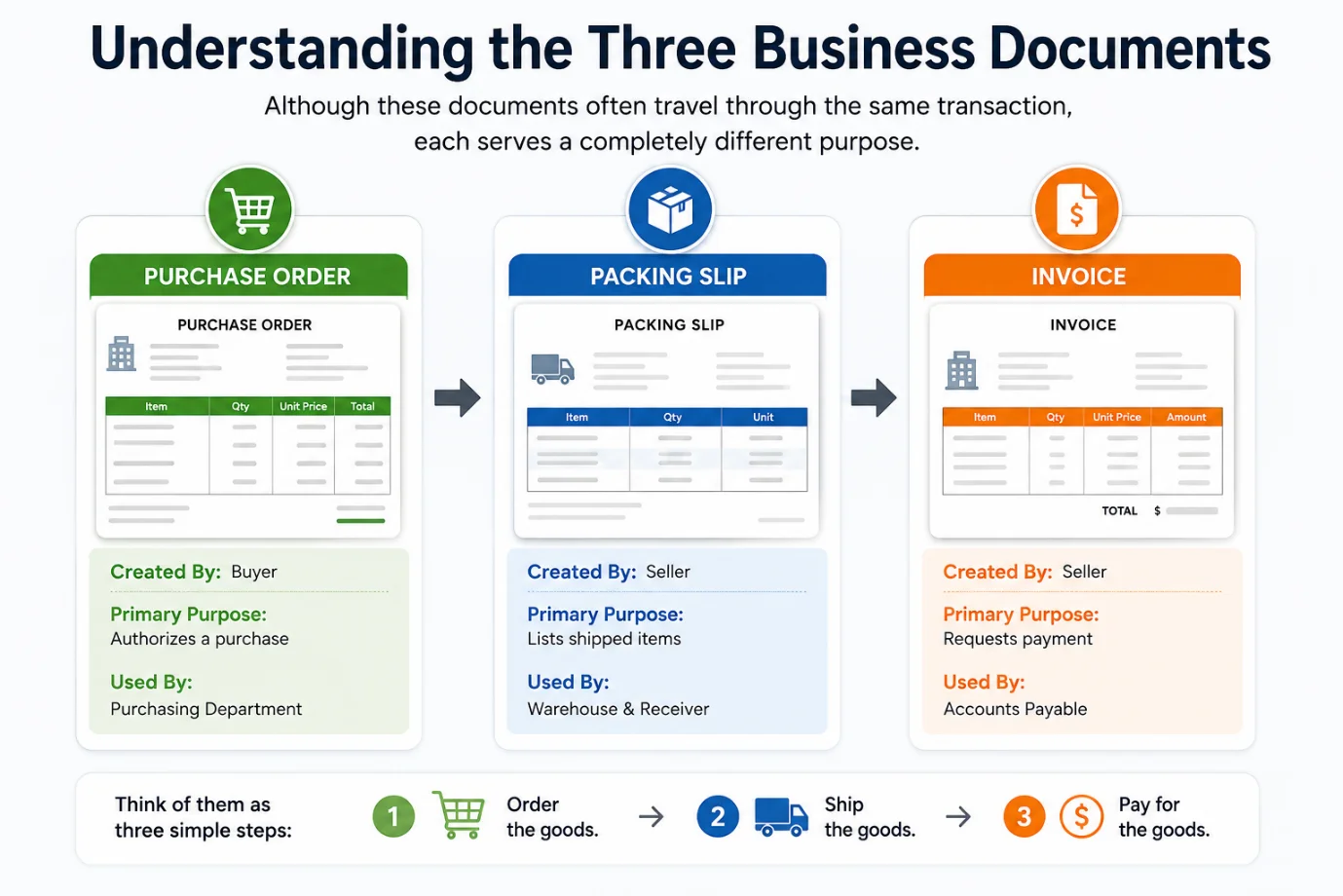
Understanding the Three Business Documents
Although these documents often travel through the same transaction, each serves a completely different purpose.
Think of them as three simple steps:
- Order the goods.
- Ship the goods.
- Pay for the goods.
Each document supports a different stage of the purchasing process.
What is a Purchase Order?
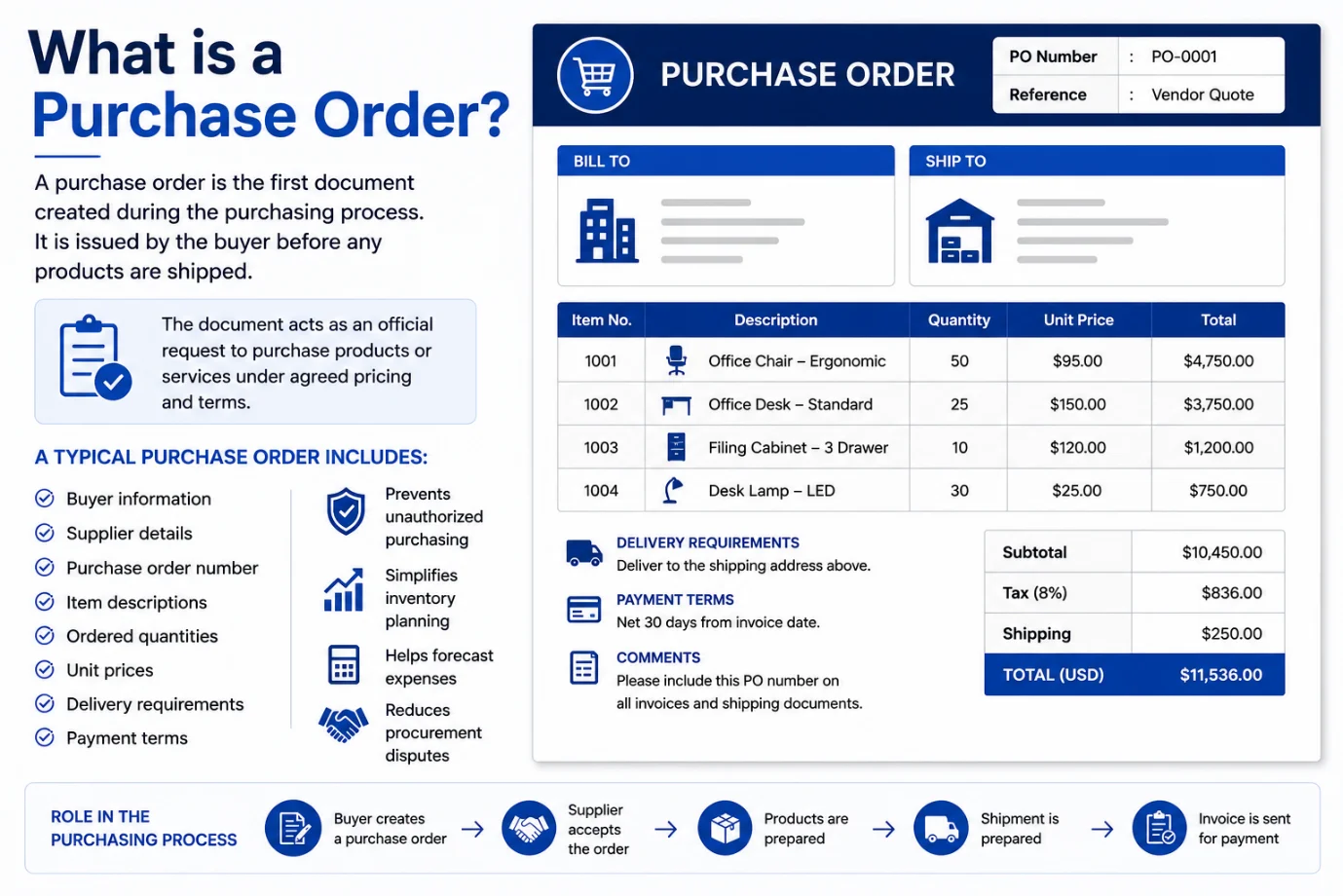
A purchase order is the first document created during the purchasing process. It is issued by the buyer before any products are shipped.
The document acts as an official request to purchase products or services under agreed pricing and terms.
A typical purchase order includes:
- Buyer information
- Supplier details
- Purchase order number
- Item descriptions
- Ordered quantities
- Unit prices
- Delivery requirements
- Payment terms
Once accepted by the supplier, it often becomes a legally recognized commercial agreement.
Benefits
- Prevents unauthorized purchasing
- Creates a clear audit trail
- Simplifies inventory planning
- Helps forecast expenses
- Reduces procurement disputes
What is a Packing Slip?
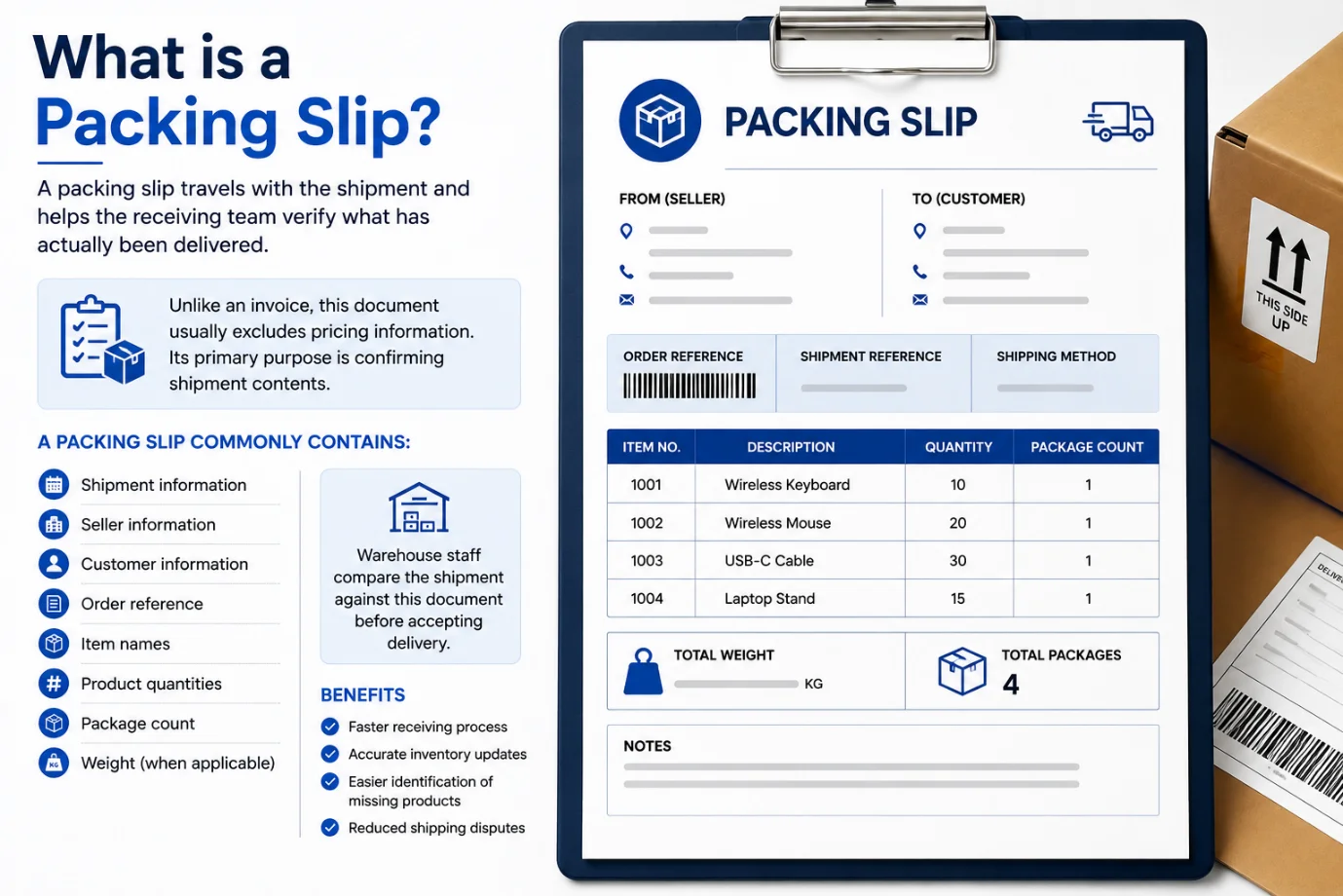
A packing slip travels with the shipment and helps the receiving team verify what has actually been delivered.
Unlike an invoice, this document usually excludes pricing information. Its primary purpose is confirming shipment contents.
A packing slip commonly contains:
- Shipment date
- Seller information
- Customer information
- Order reference
- Item names
- Product quantities
- Package count
- Weight (when applicable)
Warehouse staff compare the shipment against this document before accepting delivery. For step-by-step guidance on capturing itemized details into inventory, see our guide on extracting SKUs and quantities from packing slips.
Benefits
- Faster receiving process
- Accurate inventory updates
- Easier identification of missing products
- Reduced shipping disputes
What is an Invoice?
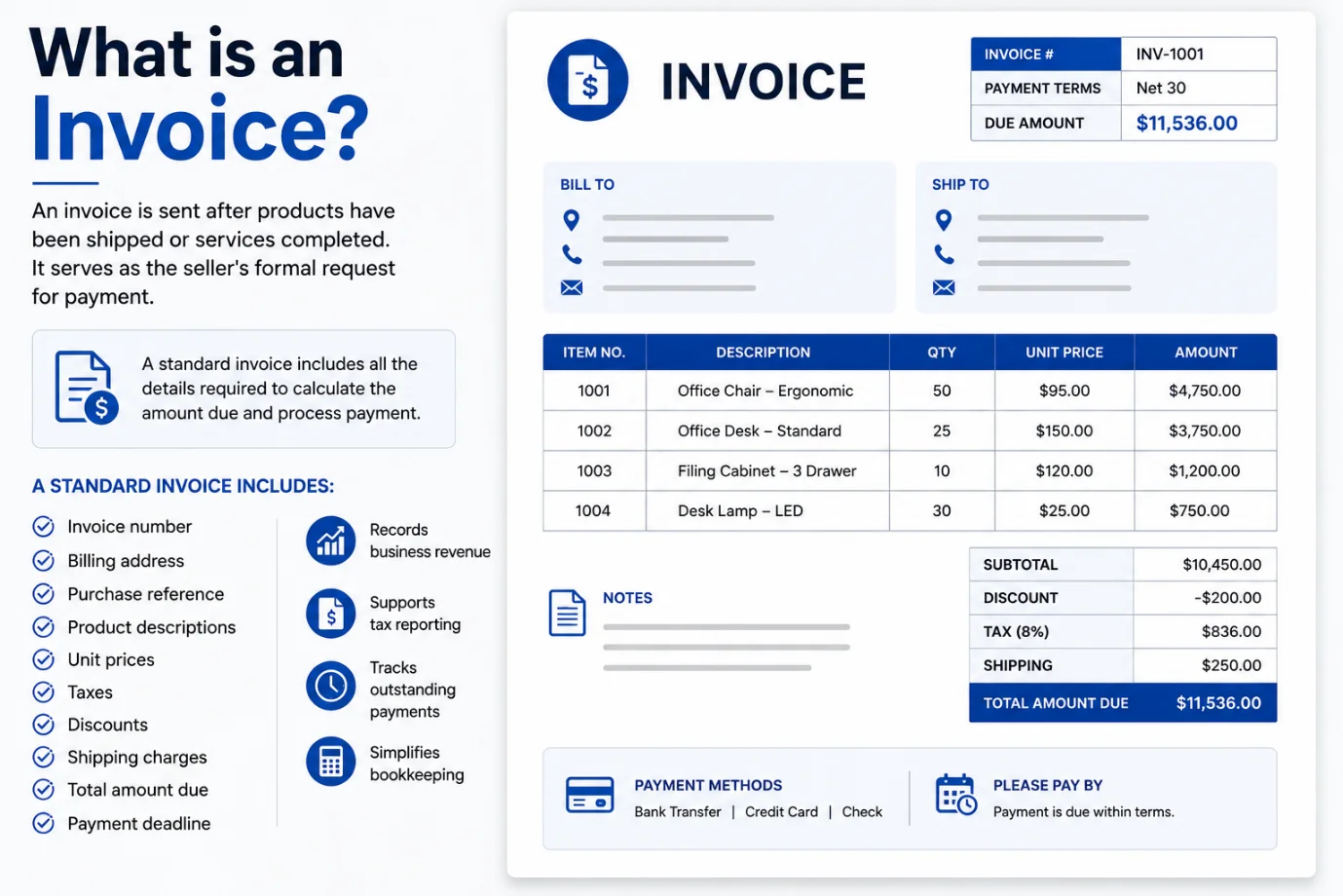
An invoice is sent after products have been shipped or services completed. It serves as the seller's formal request for payment.
A standard invoice includes:
- Invoice number
- Billing address
- Purchase reference
- Product descriptions
- Unit prices
- Taxes
- Discounts
- Shipping charges
- Total amount due
- Payment deadline
Accounting departments use invoices to process vendor payments and maintain financial records.
Benefits
- Records business revenue
- Supports tax reporting
- Tracks outstanding payments
- Simplifies bookkeeping
How These Documents Work Together
A standard purchasing process follows a predictable sequence:
- Buyer creates a purchase order.
- Seller accepts the order.
- Products are prepared.
- Shipment includes a packing slip.
- Buyer verifies the received goods.
- Seller issues an invoice.
- Buyer processes payment.
Because each document serves a different purpose, businesses should never substitute one for another.
Common Mistakes Businesses Make
Paying Before Verifying Delivery
Always compare delivered goods with the packing slip before approving payment.
Using an Invoice as a Shipping Checklist
Invoices are financial documents, not receiving documents.
Missing Purchase Order References
Failing to reference the purchase order slows invoice approval and increases manual work.
Ignoring Quantity Differences
Receiving teams should immediately report shortages or damaged products before accounting processes payment.
Practical Example
Imagine a retailer ordering 200 office chairs.
The retailer first creates a purchase order requesting 200 chairs at the agreed price.
The supplier prepares the shipment and includes a packing slip listing all 200 chairs inside the delivery.
After shipping, the supplier sends an invoice requesting payment according to the agreed terms.
Because every document matches, payment can be approved quickly with minimal manual verification.
Best Practices for Businesses
- Use unique document numbers.
- Digitize procurement records.
- Match all three documents before payment.
- Train receiving staff on document verification.
- Store documents for future audits.
- Automate document workflows where possible — such as automating packing slip data entry with Zapier and your WMS.
These practices reduce fraud, improve inventory accuracy, streamline financial operations, and strengthen supplier relationships.
Conclusion
Understanding the differences between purchase orders, packing slips, and invoices helps businesses reduce costly errors throughout the procurement process. Each document supports a specific stage from ordering goods to verifying deliveries and requesting payment.
Instead of treating these documents as interchangeable, use each one for its intended purpose. A consistent documentation process improves inventory accuracy, speeds payment approvals, strengthens supplier relationships, and creates reliable financial records for long-term business success.
Automate Packing Slip Data Extraction
Extract SKUs, quantities, and PO references from supplier packing slips directly into your WMS or ERP without manual data entry. 20 free credits included.
Try AI Packing Slip Parser Free →