
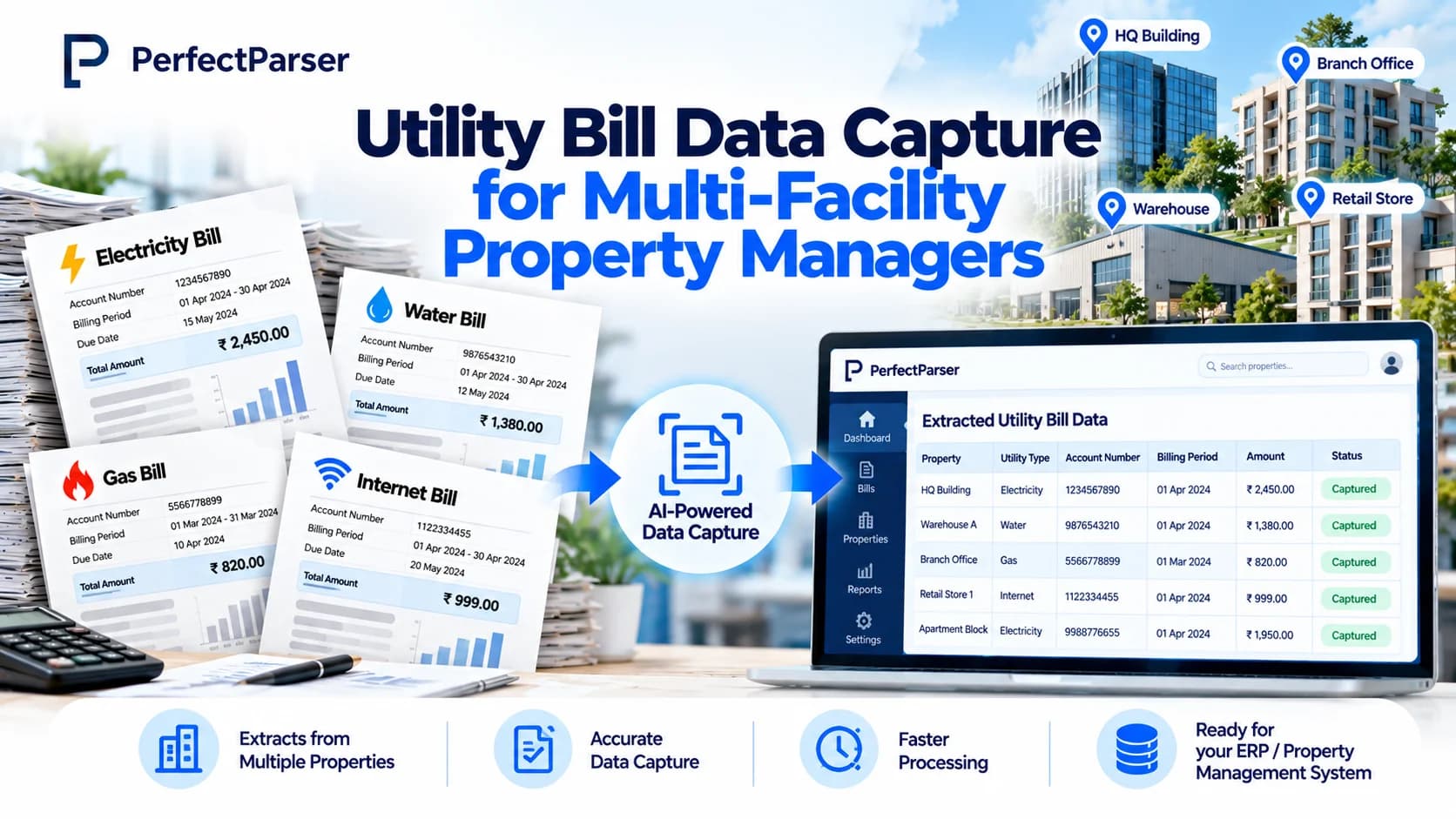
Every month, a multi-facility property manager receives hundreds of utility bills. Electricity, gas, water, and telecom bills arrive from different providers, in different layouts, by email, mail, and portal download. Someone has to read each one and key it into the accounting system before the due date. Utility bill data capture replaces that manual step. Automated utility data capture uses AI-driven utility bill data extraction to read every bill and turn it into clean, structured records. This guide explains how it works, what to capture, and how to choose a solution.
Quick answer: Utility bill data capture automates the extraction of account numbers, billing periods, meter readings, line-item charges, and taxes from electricity, gas, and water invoices across multi-property portfolios. Instead of spending 8–15 minutes manually keying each bill, AI extraction normalizes varying provider formats into a single schema, eliminates manual data entry, prevents costly late fees, and feeds clean data directly into property accounting systems like Yardi, RealPage, or AppFolio.
What Is Utility Bill Data Capture?
Utility bill data capture is the process of automatically collecting the key data on a utility bill and converting it into structured, usable fields. A PDF, scan, or emailed bill goes in. Account numbers, service addresses, billing periods, meter readings, usage, rates, and total due come out.
For property managers, the goal is not just digitizing a document. The goal is getting accurate data into the accounting or property management system fast enough to pay on time and spot problems early.
How Is Data Capture Different from Utility Bill Management?
Utility bill management is the broader discipline encompassing the entire lifecycle: collecting, auditing, approving, paying, and analyzing utility costs across an organization. Data capture is the foundational first step that feeds that entire pipeline. If data capture is slow, error-prone, or incomplete, every subsequent accounting, allocation, and audit step inherits those inaccuracies.
How Is AI Data Capture Different from Simple OCR?
Traditional OCR merely converts pixel images into unformatted, unstructured strings of text without understanding context. It cannot distinguish an account number from an invoice number, nor can it map disparate provider layouts. In contrast, AI-driven utility bill data capture reads fields by semantic meaning—identifying meter IDs, consumption quantities (kWh/therms), peak demand charges, and tariff rates regardless of where they sit on the document.
Common Utility Bill Challenges Across Multiple Facilities
A single building with two utilities is easy to run by hand. A portfolio of dozens of facilities is not. Most property teams follow the same routine each month: collect bills from many vendors, validate usage and rates, allocate charges to tenants or units, resolve discrepancies, and process payments. Manual capture strains every one of those steps.
The inbound volume bottleneck. Bills arrive continuously and through different channels, and each facility can have several accounts and meters. As industry guidance on utility data for property managers points out, manual data entry across many properties is time-consuming and error-prone (see our 2026 manual vs. AI utility bill benchmark for real-world labor calculations), which makes it hard to scale without adding headcount.
Provider formats never match. One provider says "kWh used," another says "consumption." Tariffs, demand charges, and service periods sit in different places. A team that learns one layout still has to relearn the next.
Transcription errors. Keying a meter reading or an amount by hand introduces mistakes. A misplaced digit distorts cost allocation and can hide a real billing error.
Missed and late bills. Bills that reach the wrong inbox or sit in a queue miss their due date. Analysis of the hidden costs of manual utility bill management notes that manual processes raise the risk of missed payments and the penalties that follow (which can be eliminated through automated due-date tracking).
Entering instead of auditing. When staff spend the month typing, no one questions a spike in charges or checks a bill against its tariff. Auditing, where the savings are, gets skipped. According to a review of common utility management mistakes, studies by a large utility billing auditor found that at least 17% of utility invoices contain an error, which is why unchecked bills are costly.
Tenant billing disputes. When charges are allocated to tenants from inaccurate data, complaints follow. Property management software research on utility bill-back and NOI lists manual readings and tariff research as error-prone and time-consuming, so clean source data is the fastest way to reduce disputes.
Fragmented visibility. Without one dataset, finance cannot see spend by property and sustainability teams cannot track Scope 2 carbon emissions accurately across facilities.
How Utility Bill Data Capture Works
Most AI capture systems follow the same flow.
1. Ingest bills from every channel. Bills are collected from email inboxes, uploads, shared folders, or API connections. Scans, photos, and native PDFs are all accepted.
2. Classify the document. The system identifies the bill as electricity, gas, water, or telecom, and often the provider, so it applies the right understanding.
3. Extract fields by meaning. AI models read the bill the way a person does. They look for what a value represents, such as a meter reading, tariff name, or service period, not where it sits. This is why a provider redesign does not break the process.
4. Normalize into one schema. Every provider's terminology is mapped to one set of fields. "Consumption," "kWh used," and "usage" all become a single usage field. The output looks identical whichever provider issued the bill.
5. Validate and score confidence. Each field receives a confidence score. The system checks totals against line items, dates against billing cycles, and account numbers against your property list. High-confidence bills pass straight through. Low-confidence fields are flagged.
6. Push clean data into accounting. Validated records go to your property accounting or ERP system through integration or API. Guides to AI in property utility billing describe tools that scan PDF invoices, extract the data, and code it to the correct property ledger, which removes the retyping step.
7. Route exceptions to a person. Only unclear or conflicting bills need review, and corrections can improve the model over time.
This combination of extraction, normalization, and validation is what people mean by automated utility data capture. It is also what a dedicated utility bill data extraction workflow delivers at portfolio scale.
What Data Should Property Managers Capture from Utility Bills?
Capturing too little limits what you can audit. Capturing everything without structure creates noise. Most property managers need these field groups.
Account and location data
- Account number and customer name
- Service address and property or unit identifier
- Provider name and utility type
Billing period data
- Statement date and due date
- Service start and end dates
- Previous balance and payments received
Consumption data
- Meter number
- Previous and current meter readings
- Usage in kWh, therms, gallons, or cubic meters
- Peak or demand readings, where applicable
Charge data
- Rate or tariff name
- Energy, demand, and delivery charges
- Taxes, fees, and late charges
- Total amount due
Audit and allocation data
- Estimated versus actual reading flag
- Adjustments and credits
- Fields needed to allocate cost to tenants or units
- Data for ESG and sustainability reporting
Capturing service periods and meter readings, not just totals, is what makes real auditing possible. A total alone cannot show whether the rate was right or the reading was estimated.
Benefits of Utility Bill Data Capture for Property Managers
Fewer errors. Automated extraction removes the keystroke step, where most transcription mistakes occur. Validation rules catch what remains.
On-time payments. Bills are captured the day they arrive and routed for approval, so fewer reach their due date unnoticed. The mistakes review above adds that many utilities charge late fees equivalent to a 12% to 36% annual interest rate, so timing matters to net operating income.
Time returned to the team. Staff move from typing to reviewing exceptions and auditing charges.
A PerfectParser outcome to aim for. With PerfectParser, property teams can target 85%+ of bills of bills processed straight through with no manual touch, and the remaining exceptions reviewed in minutes rather than hours.
Stronger auditing. Structured data lets you compare usage month over month, flag spikes, and check charges against tariffs.
Fewer tenant disputes. Accurate, consistent source data means allocated charges are easier to explain and defend.
Cost analysis without extra work. Once every bill sits in one schema, you can spot abnormal usage, rate inconsistencies, and consumption trends across properties.
One dataset for every team. Finance sees spend by property, operations sees usage trends, and sustainability pulls reporting figures from the same normalized source.
Scalability. A new facility or provider does not require a new template or another hire. The same models handle the new format.
How to Choose a Utility Bill Data Capture Solution
Property managers generally have three routes: keep capture in-house with manual entry, outsource it to a service team, or use AI-based capture software. In-house entry is simple to start but does not scale and stays error-prone. Outsourcing gives access to specialists but adds a handoff and ongoing labor cost. AI capture gives speed and consistency, with people reviewing only exceptions.
Whichever route you choose, evaluate these criteria.
Template-free extraction. Ask whether the tool needs a template per provider. Template-based systems require setup for each new format and fail when a provider redesigns its bill.
Accuracy you can verify. Request accuracy by field, not just a headline percentage, and test with your own bills, including poor scans.
Confidence scoring and validation. Look for field-level confidence and rules that cross-check totals, dates, and account numbers.
All utility types in one workflow. Electricity, gas, water, sewer, and telecom should be handled together, including multi-meter bills.
Accounting and property system integration. The value comes from clean data landing in your system. Check for API, webhook, or native connections.
Fast exception handling. Review should show the field, its location on the bill, and the reason it was flagged.
Security and access control. Bills contain account and address data. Confirm encryption, role-based access, and audit logs.
Start with a pilot on a representative batch of bills. Results from your own providers are more reliable than any vendor benchmark.
Automate Utility Bill Capture Across Your Entire Portfolio
Capture account numbers, sub-meter readings, peak demand, and line-item charges across all regional providers without building templates. Streamline tenant bill-backs (RUBS) and sync clean records directly to your property accounting software. 20 free credits included.
Explore Utility Data Capture Solutions →