
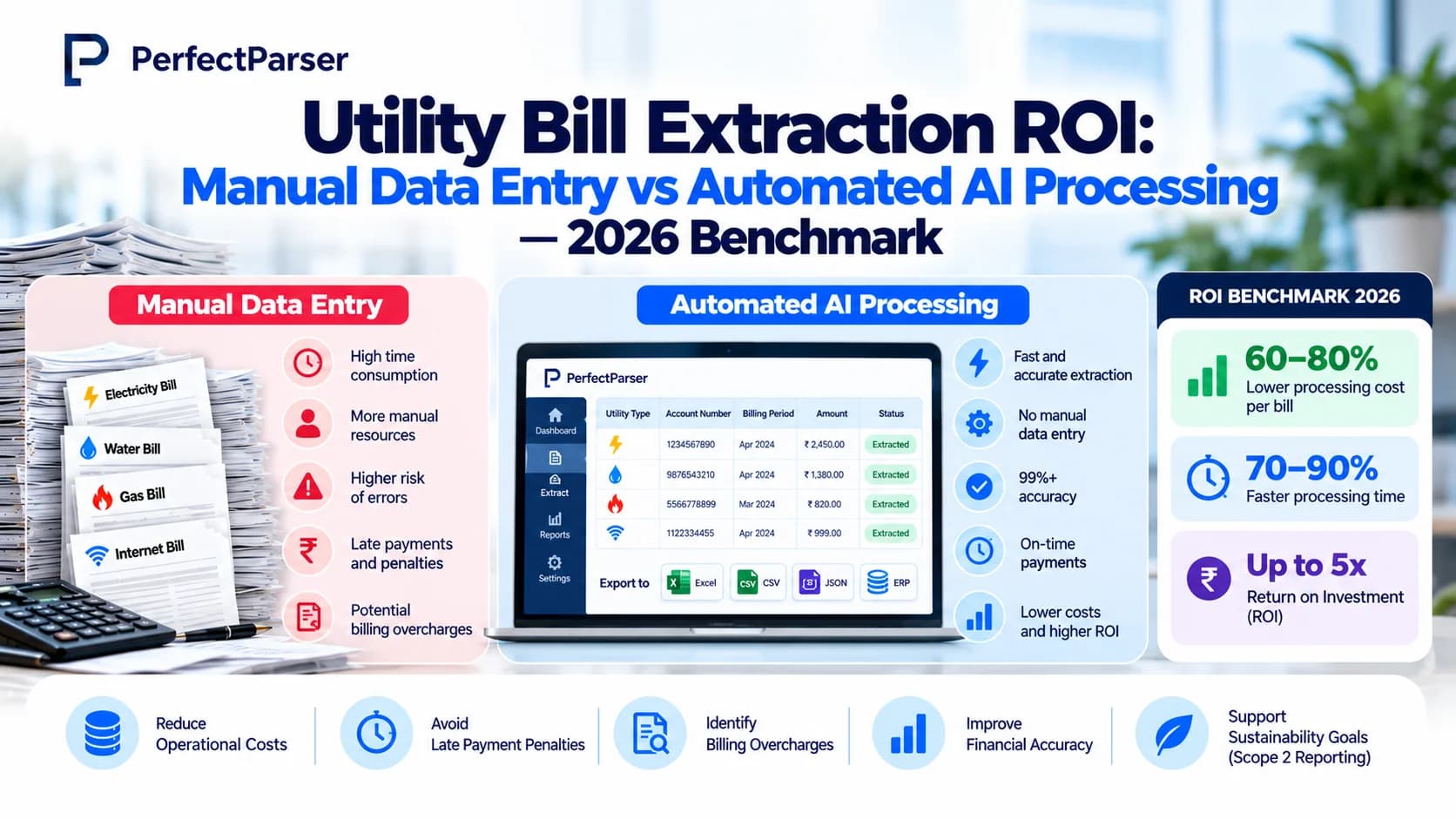
Quick answer: Processing utility bills manually costs an estimated $4.67 to $8.75 in direct labor per invoice (based on 8 to 15 minutes of keying at a loaded $35/hr rate). However, hidden costs—including 12%–36% late payment penalties, a 17% billing error rate, and unvalidated demand charges—often double that expense. AI utility bill processing cuts processing time by 80%+, automates due-date tracking, and validates line items against contract tariffs before payment.
Most finance, accounting, and multi-facility property teams cannot state what a single utility bill costs to process. The expense remains invisible because it is scattered across AP headcount, queue delays, penalty fees, and tariff overcharges that nobody has time to audit.
This 2026 benchmark breaks down the true cost of manual utility bill processing against automated AI extraction. We examine published labor data, audit findings, and mathematical formulas so you can benchmark your own portfolio and determine when automation pays for itself.
Benchmark Methodology and Assumptions
A benchmark is only useful if the underlying methodology is transparent. This model combines three core components:
- Published ranges: Time, error rate, and labor figures originate from operational studies describing commercial AP workflows. Where industry sources differ, we use conservative ranges rather than single estimates.
- Transparent formulas: Every calculation shows its exact inputs, allowing you to replace our figures with your organization's actual numbers.
- Conservative baseline assumptions:
- Manual processing: A person opens each PDF or paper bill, keys line-item details into accounting software, and manually forwards it for sign-off.
- Automated AI processing: Software ingests documents from email or uploads, reads values by semantic meaning, cross-checks totals and dates, and routes only low-confidence flags for human review.
- Fully loaded labor rate: Assumed at $35.00 per hour ($0.58/minute), accounting for payroll taxes, benefits, workspace, and software overhead.
- Straight-through processing: 85%+ of bills pass through with zero human touch; remaining exception bills average 3 minutes of review.
Manual vs. AI Utility Bill Extraction: Cost, Time and Accuracy
Time per Bill
Published workflow studies estimate that a skilled operator requires 8 to 15 minutes per utility bill, depending on document complexity. Utility invoices are notoriously dense: unlike standard two-line vendor invoices, a single commercial electric bill often contains previous and current meter readings, meter multipliers, peak demand (kW), consumption (kWh), power factor charges, municipal riders, and environmental surcharges.
At 500 bills per month, manual keying demands 67 to 125 hours of administrative labor—consuming the better part of a full-time accounting role. In multi-site enterprises where 50 locations generate 3,000 bills annually, manual handling consumes roughly 500 hours per year.
Cost per Bill
Converting time into direct labor expenses using a loaded $35/hour rate:
- 8 minutes per bill = $4.67 in direct labor.
- 15 minutes per bill = $8.75 in direct labor.
This covers initial data entry alone. When accounting for managerial approval handoffs, exception research, and payment scheduling, commercial processing costs easily exceed $12.00 to $18.00 per invoice.
Accuracy & Consistency
Manual entry error rates on complex utility invoices typically range between 2% and 5%. In a monthly batch of 500 invoices, that introduces 10 to 25 errors every month into accounting ledgers.
Where AI document extraction excels is not simply processing velocity—it is consistency. An accounts payable clerk typing their 300th invoice of the week is vulnerable to fatigue and transposed numbers. An AI engine applies the exact same mathematical verifications, tariff comparisons, and validation logic to every page. That clean baseline is also what makes data trustworthy enough to feed downstream corporate Scope 2 carbon accounting without requiring secondary manual audits.
The Two Cost Multipliers: Late Payment Penalties & Billing Overcharges
The visible cost of manual handling is typing time. The larger financial leakage sits in penalty fees and unchecked rate overcharges.
1. Late Payment Penalties: The Cost of Queue Delays
Commercial utility bills typically carry shorter payment terms than standard Net-30 vendor invoices—often 14 to 21 days from the meter read date.
When bills arrive across fragmented channels (mail, decentralized site inboxes, and utility portals), they sit in administrative backlogs. By the time an accounts payable specialist keys the data and obtains department sign-off, the grace period has expired.
Utility providers penalize late payments aggressively:
- Many utilities assess penalty fees between 1.5% and 3% per month, representing an annualized penalty rate of 18% to 36%.
- Late payments jeopardize utility credit deposits and risk service interruptions that halt building operations.
- In multi-facility portfolios, recurring late fees quietly drain thousands of dollars annually across dozens of accounts.
How automation solves late fees:
- Day-One Due Date Capture: The instant an invoice arrives, AI extracts the payment deadline, billing window, and grace period terms into structured data.
- Expected-Bill Calendar: The system maintains an expected schedule for each meter account. If an invoice has not arrived by its expected cycle date, an automated alert flags the missing bill before penalty deadlines approach.
- Payment Lead-Time Scheduling: Approvals are automatically scheduled backwards from the due date, ensuring invoices reach approvers with comfortable lead time.
2. Unaudited Overcharges: The Cost of Inadequate Capacity
When an AP team is overwhelmed by data entry volume, invoices that "look about right" receive rubber-stamp approval. But utility bills frequently contain hidden discrepancies:
- Wrong Rate Schedules (Tariffs): Commercial providers maintain dozens of rate tiers. If a facility's tariff classification changes or a legacy schedule is misapplied, the customer is billed at a higher rate per kWh.
- Uncorrected Estimated Reads: When a utility cannot physically access a meter, it bills based on historical estimates. If subsequent bills fail to true up the estimate against actual reads, organizations pay for unconsumed energy.
- Demand Charge Spikes & Ratchets: On commercial electric bills, demand charges (measured in kW peak) often represent 30% to 70% of the total cost. A single erroneous demand reading can establish an inflated "ratchet" minimum that inflates bills for the next 11 months.
- Meter Multiplier Errors: Industrial meters use multipliers (e.g., ×40 or ×120) to calculate actual usage. A transposed multiplier on a statement multiplies financial exposure exponentially.
- Duplicate Billing & Overlapping Periods: Meter replacements or administrative provider shifts often generate overlapping service dates or duplicate invoices for closed accounts.
Data and audits published across commercial real estate and energy management sectors reveal that at least 17% to 20% of commercial utility bills contain billing errors or discrepancies. Studies by utility expense management leaders such as ENGIE Impact and property management automation provider Zego consistently benchmark this 17%+ baseline error rate across enterprise utility accounts. Furthermore, the American Association of Utility Bill Auditors (AAUBA) notes that commercial tariff misclassifications and peak demand ratchet errors account for the majority of undetected overcharges.
When organizations extract bills into structured data, automated validation rules catch these discrepancies instantly before payment is remitted.
Worked Illustration: The Compounding Impact of a 9% Error (Real-World Evidence)
To understand how easily billing errors slip past manual review, consider a common commercial tariff misclassification documented in utility audits:
- Scenario: A commercial property contract specifies an agreed large-commercial tariff of $0.095 per kWh. Due to a provider billing system update, the account is inadvertently billed on a standard general service tariff of $0.104 per kWh (a 9.47% rate discrepancy).
- Consumption Overcharge: On a monthly consumption of 82,000 kWh, the $0.009/kWh discrepancy results in a direct $738.00 overcharge in a single month.
- Demand Charge Error: In addition, the utility's bill records billed demand at 455 kW, whereas the facility's interval meter log showed actual peak demand capped at 410 kW. At a typical commercial demand charge of $12.00/kW, this 45 kW error adds $540.00 in unearned charges.
- Total Monthly Leakage: $1,278.00 on a single invoice.
Because the total bill amount falls comfortably within the building's historical seasonal budget, an accounts payable clerk skimming the document would approve it without hesitation. Automated AI validation compares extracted line items directly against contract tariff tables and flags the exact line-item discrepancy with supporting evidence.
How to Calculate Your Organization's Utility Bill ROI
To calculate your organization's potential return on investment, use this 4-step framework:
Master ROI Formula:
Net Annual Savings = (Annual Labor Saved + Late Fees Avoided + Overcharges Recovered) − Annual Automation Cost
Step 1: Calculate Annual Labor Hours
Calculate how many staff hours are currently spent opening, keying, and routing utility bills each year:
Annual Labor Hours Formula:
Annual Labor Hours = (Monthly Bill Volume × 12 × Minutes per Bill) ÷ 60
Example Calculation: A mid-sized organization processing 400 bills per month at an industry-average 12 minutes per bill:
- Total Annual Bills: 400 bills/month × 12 months = 4,800 bills annually.
- Annual Keying Time: (4,800 × 12) ÷ 60 = 960 hours of annual data entry.
Step 2: Calculate Direct Labor Expense
Multiply your total annual hours by your team's fully loaded hourly rate (salary + taxes + benefits + overhead):
Direct Labor Cost Formula:
Direct Labor Expense = Annual Labor Hours × Loaded Hourly Labor Rate
Example Calculation:
- 960 hours × $35.00/hour loaded labor rate = $33,600.00 in annual direct keying costs.
Step 3: Estimate Avoidable Penalties and Overcharges
Add the hard-dollar savings from eliminating operational friction:
- Late Payment Penalties: Measure historical late fees across your accounts. For a 400-bill monthly portfolio, late fees typically tally between $2,400 and $6,000 annually due to short 14- to 21-day payment cycles and administrative queue delays.
- Billing Overcharges Recovered: With utility audits documenting a 17% error rate, recovering even a conservative 0.5% in overcharges across $1.5M in annual utility spend returns $7,500.00 in annual recovered capital.
Step 4: Compare Against Automation Costs
Measure your net savings and timeline to break even:
- Automated Processing Time: With AI extraction, 85%+ of bills process straight-through with zero human intervention. The remaining 15% exceptions reviewed at 3 minutes each require just 36 hours of annual staff review ($1,260.00 in labor).
- Net Labor Savings: $33,600.00 − $1,260.00 = $32,340.00 in annual labor freed.
- Total Annual Gross Value: $32,340 (labor) + $4,000 (penalties avoided) + $7,500 (overcharges recovered) = $43,840.00 in gross annual financial benefit.
- Payback Period: Subtract net monthly operational savings from software subscription costs; most portfolios achieve 100% ROI payback within 3 to 8 weeks.
How PerfectParser Automates Utility Bill Data Extraction
PerfectParser replaces manual utility bill keying with template-free AI document extraction designed for multi-provider portfolios:
- Template-Free Extraction: Automatically parses invoices from thousands of electric, gas, water, and telecom providers by understanding field semantics rather than fixed coordinate grids.
- Unified Normalized Schema: Converts disparate utility formats into a single, standardized schema covering meter IDs, read dates, consumption units, peak demand, tariffs, and taxes.
- Field-Level Confidence Scoring: Validates mathematical totals, date continuity, and contract rate tables—routing only uncertain fields to staff for rapid review.
- Direct ERP & Accounting Integration: Pushes clean, coded records directly into accounting software, property management systems, or downstream Scope 2 emissions tools.
- Audit-Ready Evidence: Keeps every extracted field permanently linked to the original document image to streamline provider disputes and financial audits.
Eliminate Manual Utility Bill Keying Costs & Late Penalties
Stop spending 8–15 minutes keying utility PDFs. Use PerfectParser's AI utility bill extractor to parse line items, verify contract tariffs, and capture due dates automatically before penalties accrue. 20 free credits included.
Try AI Utility Bill Extraction Free →