
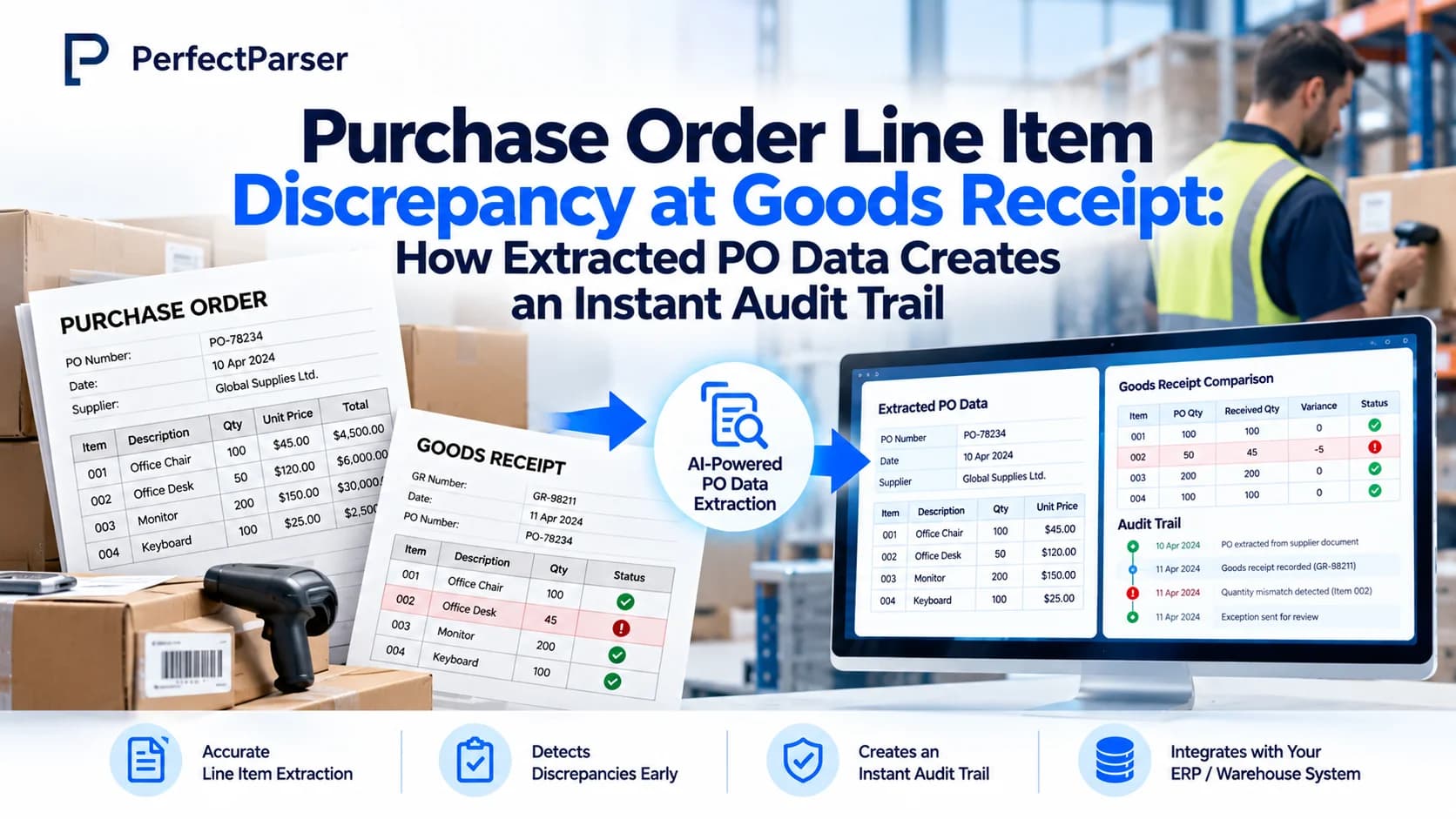
Quick answer: A purchase order line item discrepancy at goods receipt occurs when physical deliveries differ from the original PO in quantity, SKU, or condition. By extracting static PO PDFs into structured, searchable line-item data, warehouse receiving teams can verify shipments in seconds, generate timestamped audit trails, and resolve supplier claims before legal dispute windows close.
What Is a Purchase Order Line Item Discrepancy at Goods Receipt?
A purchase order line item discrepancy at goods receipt is any variance between an individual line on an issued purchase order and what physically arrives at the receiving dock. Common variances include short shipments, over-shipments, incorrect SKUs, mismatched units of measure, or damaged merchandise.
Consider a standard receiving scenario: An operations team issues a PO for 100 units of a sub-assembly at $12.50 each ($1,250 total). At the receiving dock, the shipment arrives with only 96 usable units; 4 units arrived damaged and were rejected. Under standard accounts payable control procedures, three-way matching compares the purchase order, the goods receipt note (GRN), and the vendor invoice to ensure payment is disbursed only for verified, accepted goods.
Inbound receiving discrepancies typically fall into distinct categories:
- Quantity variances: Physical unit counts differ from the PO (shortages or unauthorized over-shipments).
- SKU or catalog mismatches: Wrong parts delivered, mislabeled cartons, or mixed product codes.
- Package count variances: Discrepancies between carrier bill of lading carton counts and physical pallet counts.
- Condition & quality defects: Transit damage, seal tampering, or moisture exposure identified at receipt.
- Documentation discrepancies: The physical delivery does not match the vendor packing list (see our guide to packing slip data extraction).
Understanding these variances is central to effective inbound logistics management. While accounts payable focuses on purchase order invoice processing errors, warehouse operations must catch physical discrepancies the moment the truck arrives at the bay.
Common Causes of PO Line Item Discrepancies
Most receiving discrepancies originate upstream, but internal operational friction frequently compounds them:
Typical root causes include supplier fulfillment errors, carrier freight consolidation mistakes, damage during transit, unit-of-measure confusion (e.g., shipping 10 cases instead of 10 eaches), and barcode scanning errors at the receiving dock.
However, an overlooked contributor is inaccessible, unstructured PO data. When receiving dock workers cannot easily access purchase order line items, they frequently perform superficial carton counts rather than piece-level verifications. Alternatively, they check shipments against outdated order revisions that have already been modified.
Accurate goods receipt requires instantaneous access to structured purchase order line-item data. Warehouse teams cannot catch discrepancies they cannot readily verify.
How Manual PO Data Entry Leads to Matching Errors
In traditional, manual warehouse environments, handling discrepancies is slow and reactive:
- Shipment arrives with discrepancies: The warehouse receiver spots damaged boxes or uncataloged SKUs.
- Staff search for the original PO: The purchase order is buried as a PDF in an email thread, ERP screen, or shared network folder.
- Manual line-by-line review: The worker opens the PDF and searches through multi-page tables to find matching line items. On complex orders with dozens of lines, cross-referencing takes hours.
- Data transcription: Discrepancy counts are jotted on paper or re-typed into a spreadsheet, introducing new transcription errors.
- The supplier claim window expires: By the time the PO is located and verified, the delivery truck has departed, carrier bills of lading are signed clean, and the supplier's contractual dispute window has closed.
This creates two critical liabilities: lost time (preventing prompt dispute filing) and unreliable records (comparing delivery counts against miskeyed ERP records). Standard order discrepancy management breaks down completely when paperwork is fragmented across siloed folders.
How PO Data Extraction Detects Line Item Discrepancies
Automated PO extraction resolves receiving discrepancies by transforming static purchase orders into structured, searchable line-item data before shipments arrive.
The end-to-end workflow operates seamlessly:
- Capture the PO: Purchase order OCR ingests purchase orders upon issuance, converting PDFs, scans, and emails into structured records.
- Extract Line Items: AI extracts line items—SKU, item description, ordered quantity, unit of measure, unit price, and expected delivery date—into structured databases.
- Confidence Scoring: High-accuracy extraction verifies data integrity before records post to the WMS or ERP.
- Searchable Dock Access: The PO line-item record is accessible to dock receivers via handheld scanners or warehouse terminals by scanning the PO barcode or vendor packing slip.
- Real-Time Dock Matching: When delivery counts are entered, the system performs an instant line-by-line comparison against the PO. Quantity variances and wrong SKUs are highlighted in red immediately.
With structured line items, receiving teams verify deliveries in seconds, stopping discrepancies before shipments are formally accepted into inventory.
How Extracted PO Data Creates an Instant Audit Trail
An audit trail is an immutable, timestamped record documenting what was ordered, what was physically received, and what resolution was decided. Automated PO extraction creates this audit record naturally during intake without additional administrative overhead.
A comprehensive goods receipt audit trail captures:
- The original purchase order line items extracted from the vendor source document (with source PDF attached)
- Documented PO revisions, amendments, and change timestamps
- Scanned vendor packing list data (see our guide to extracting SKUs from packing slips)
- Line-by-line comparison logs: accepted, short-shipped, over-shipped, or rejected
- Attached inspection photographs of damaged packaging or defective items
- User IDs for receiving personnel and approvers
- Final resolution status: accepted with debit memo, returned to vendor, or credited
Because this data is recorded in real time, procurement and AP never have to reconstruct shipping disputes from fragmented memory weeks later.
Manual Tracking vs Extracted PO Data Audit Trails
How an Audit Trail Helps Resolve Supplier Disputes
Supplier dispute outcomes depend on verifiable evidence and prompt notification. Most B2B supplier agreements impose strict 24-to-48-hour windows for reporting short shipments or damaged freight.
An automated audit trail accelerates dispute resolution across three dimensions:
- Instant Claim Generation: When a shortage is identified at the dock, the claim is auto-populated with the exact SKU, quantity ordered, quantity received, and deficit. Claims are dispatched the same day.
- Definitive Evidence: Rather than vague complaints ("we were missing items"), suppliers receive an itemized, timestamped discrepancy report complete with receiving photos and signed carrier delivery notes.
- Faster Financial Reconciliation: Clear evidence enables rapid agreement on credit memos, short-payments, or replacement shipments, ensuring AP adjusts payments accurately. (To verify matched invoice amounts, use our free PO to invoice matching tool).
A standardized dispute workflow:
- Flag line-item discrepancy at receipt and attach comparison log.
- Notify procurement and supplier representatives the same business day.
- Transmit the audit report containing extracted PO lines, delivery counts, and inspection photos.
- Agree upon resolution (replacement vs credit memo) and log the decision against the PO line.
- Transmit verified receiving records to accounts payable so invoice matching proceeds accurately.
How Extracted PO Data Protects the Supply Chain
Structured PO line-item data provides operational safeguards far beyond the receiving dock:
- Powers Automated Three-Way Matching: Seamlessly aligns the PO, goods receipt, and vendor invoice for touchless AP approval (see PO invoice processing errors).
- Preserves Inventory Accuracy: Capturing shortages at intake prevents phantom inventory counts, stockouts, and backorders.
- Enforces Supplier Accountability: Operations can track supplier receiving accuracy rates over time, using hard performance metrics during vendor contract negotiations.
- Minimizes Dispute Resolution Latency: Reduces the time required to resolve supplier disputes from weeks to hours.
- Strengthens Procurement Governance: Ensures complete visibility across the procure-to-pay lifecycle, as benchmarked in our purchase order processing cost analysis.
If your warehouse operations still rely on printed PDFs or manual spreadsheets to verify shipments, transitioning to automated data extraction provides immediate visibility. Explore how PerfectParser's purchase order data extraction turns static documents into structured, actionable inventory data.
Turn Purchase Orders into Instant Receiving Audit Trails
Transform static PO PDFs into structured, searchable line items. Catch short shipments, overages, and wrong SKUs at the dock before dispute windows expire. 20 free credits included.
Streamline Dock Receiving Audits →