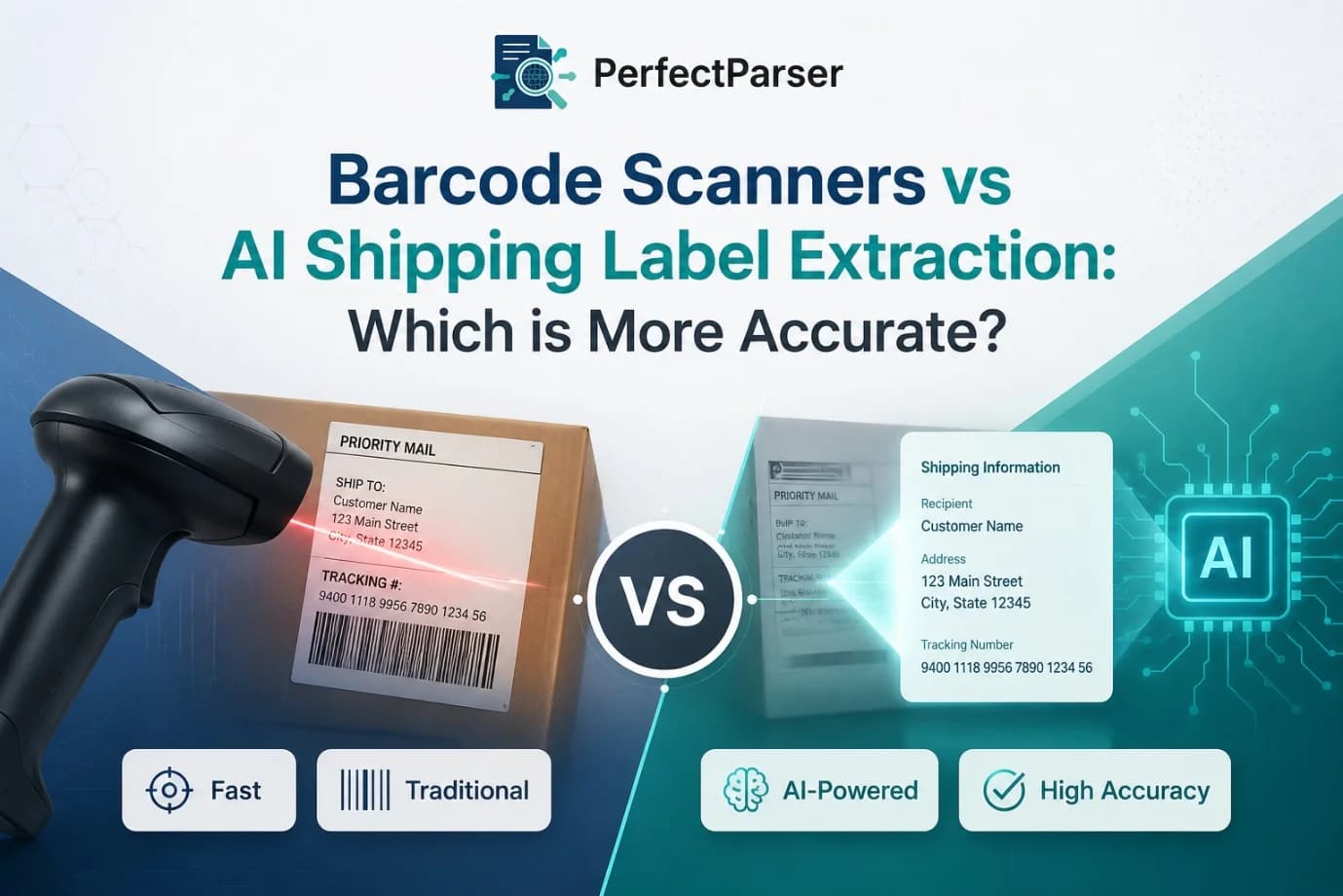
The logistics and fulfillment industry processes millions of packages daily. Each one carries critical information on a shipping label—destination address, tracking number, weight, special handling instructions. For decades, businesses relied on manual data entry or handheld barcode scanners. Today, shipping label OCR software powered by artificial intelligence is transforming how companies capture, validate, and process this information at scale. If you are new to this technology, you can learn the basics of how to extract data from shipping labels automatically.
But which approach actually works better? Barcode scanners are proven, reliable, and widely deployed. Yet when comparing barcode scanners vs AI OCR, modern intelligent systems now outperform traditional methods in speed, accuracy, and cost efficiency. This guide walks you through how both technologies work, compares their real-world performance, and helps you decide which solution fits your operation.
What you'll learn:
- •What traditional barcode scanners and AI-powered alternatives differ
- •Accuracy metrics and failure points in each approach
- •When to use each technology and when to combine them
- •Implementation strategies and best practices
- •Real-world performance indicators
Understanding Traditional Barcode Scanning
Barcode scanners have been the backbone of shipping and logistics since the 1980s. These devices read one-dimensional (1D) or two-dimensional (2D) barcodes using optical sensors and convert the encoded data into digital information.
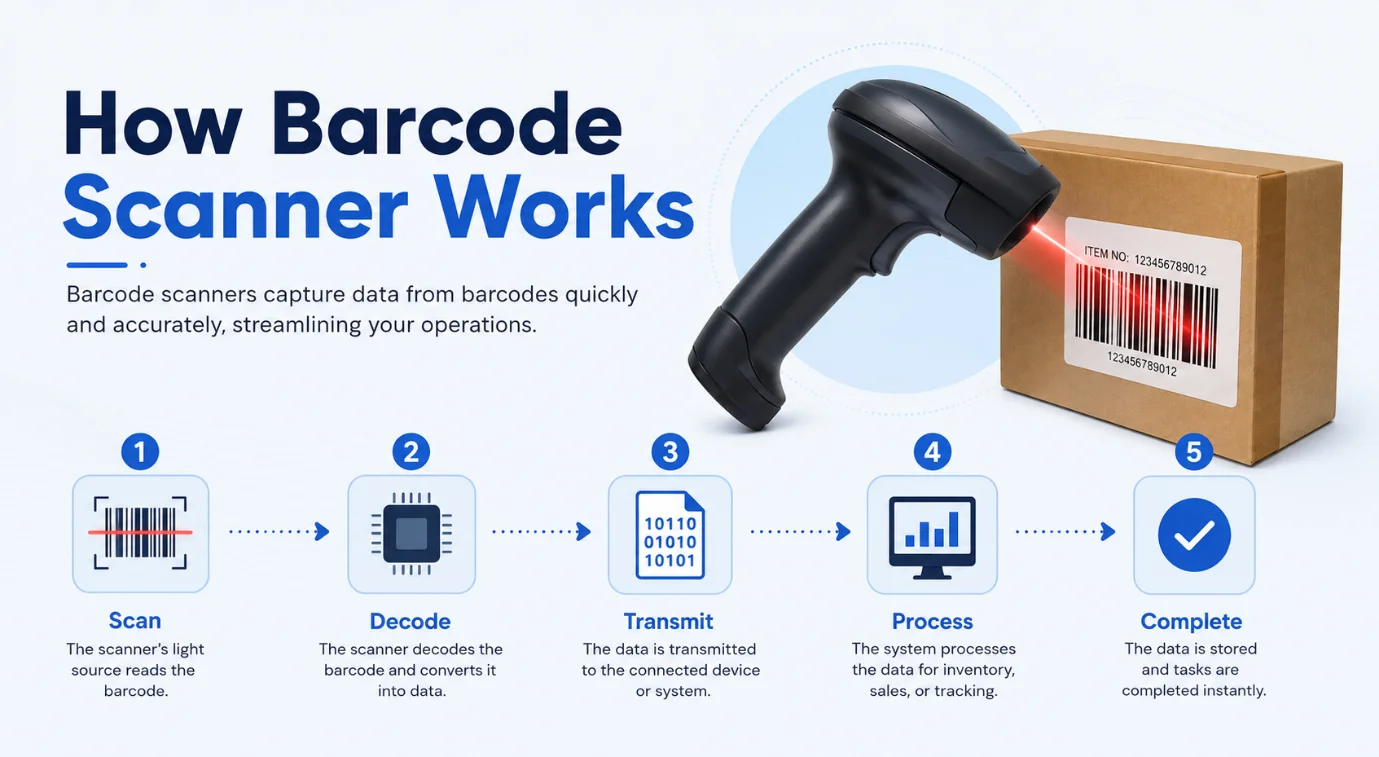
How barcode scanners work:
A barcode scanner emits light (usually red or infrared) onto a barcode printed on your shipping label. The scanner detects the reflected light and interprets the pattern of bars and spaces. For 2D codes like QR codes, the scanner captures a matrix pattern and decodes it into data. This data—typically a tracking number, shipper ID, or service type—appears on your screen instantly.
The process is remarkably fast. A skilled operator can scan 300–500 labels per hour. Barcode scanners require no external internet, minimal training, and integrate with almost any warehouse management system (WMS). They're also durable; many facilities have scanners running for 5+ years without replacement.
Limitations of barcode scanning:
The technology has real constraints. Barcode scanners require a clearly printed, properly oriented barcode. Smudged barcodes, poor lighting, or damaged labels cause read failures—typically 2–5% of packages in typical warehouse operations. When a barcode won't scan, an operator must manually key in the tracking number, introducing human error.
Barcode scanners also capture only what's encoded in the barcode itself. If you need address information, weight, dimensions, or special handling flags, that data must come from other systems or manual entry. You're also dependent on vendors to ensure barcodes are printed correctly; inconsistent print quality across suppliers becomes a constant headache.
For international shipments, barcode standards vary by country and carrier, requiring different scanner hardware or software configurations.
The Rise of AI-Powered Label Intelligence
AI label recognition represents a fundamental shift in how shipping data enters business systems. Rather than relying on a machine-readable barcode, these solutions use computer vision and machine learning to read and extract information directly from a shipping label image—the addresses, barcodes, weights, service types, and even handwritten notes.
How AI-powered systems work:
An intelligent shipping label processing system begins with image capture. This might be a smartphone photo, a mounted camera scanning packages on a conveyor, or a flatbed scanner. The system uploads the image to a cloud-based AI engine.
The AI performs several tasks simultaneously:
- •Barcode detection and reading – It locates any barcodes on the label and decodes them (just like a scanner, but from an image).
- •Text extraction – It identifies and reads all printed text: destination address, shipper address, tracking numbers, weight, dimensions, service level.
- •Layout understanding – It recognizes the structure of the label, understanding which fields are which (e.g., "This is the recipient address, this is the shipper").
- •Anomaly detection – It flags suspicious patterns, like mismatched weights, missing fields, or potentially fraudulent addresses.
- •Validation – It cross-references the extracted data against known carriers, address formats, and regulatory requirements.
The entire process takes 2–5 seconds per label. The system returns structured data: parsed address components, normalized phone numbers, validated service types, and confidence scores for each extracted field.
Advantages of AI-driven approaches:
- •Captures more data – You get address details, weights, and special instructions automatically; no need to cross-reference multiple systems.
- •Handles poor quality – Faded printing, bent corners, coffee spills, and glare don't stop AI systems the way they stop barcode scanners.
- •Reduces manual touchpoints – Fewer failed reads mean fewer operator interventions and less data entry.
- •Scales easily – Process 10,000 or 100,000 labels per day without adding hardware or headcount.
- •Provides actionable insights – AI systems flag address anomalies, weight discrepancies, and compliance issues in real time.
Accuracy Comparison: Numbers That Matter
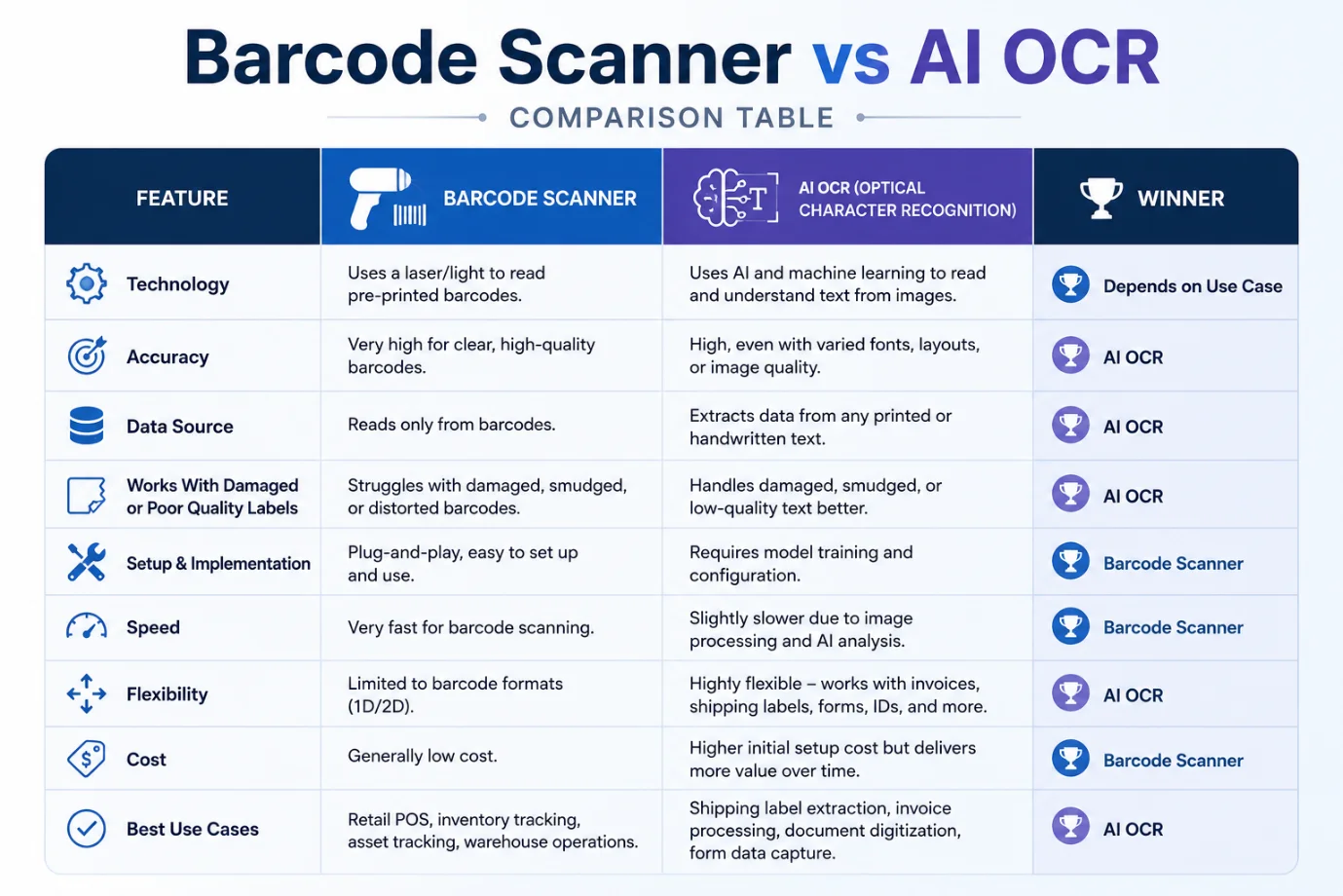
When we talk about accuracy, we need to define what we're measuring. A barcode scanner's "accuracy" is the percentage of labels it successfully reads. An OCR for shipping labels system measures accuracy differently: the percentage of extracted data fields that are correct.
Barcode scanner accuracy:
Modern barcode scanners achieve 95–99% read rates under normal conditions. The 1–5% failure rate typically comes from:
- •Damaged or faded barcodes (most common)
- •Poor label printing from carriers or shippers
- •Operator error (wrong angle, distance, lighting)
When a read fails, the label doesn't move forward automatically; it requires manual intervention. This creates bottlenecks and downstream delays in processing.
AI OCR accuracy:
Automated label data capture systems report field-level accuracy rates of 94–99%, depending on label quality and training. However, "accuracy" here means different things:
- •Barcode extraction accuracy (if a barcode is present): 98–99.5% (comparable to or better than optical scanners)
- •Address field accuracy (shipper and recipient address): 96–98%
- •Weight and dimension accuracy: 95–97%
- •Special instruction accuracy (fragile, signature required, etc.): 90–95%
The advantage: even when accuracy isn't perfect, the system flags low-confidence extractions. An operator reviews only genuinely ambiguous labels—maybe 2–3% of the volume—rather than every failed read.
Real-world performance comparison:
The data shows AI logistics document processing significantly improves data completeness and reduces the volume of manual reviews needed. But accuracy alone doesn't determine which technology is "better"—integration complexity, your current workflow, and specific business requirements matter too.
When to Use Each Technology (And When to Combine Them)
Use traditional barcode scanners when:
- •You have high-quality, consistently printed barcodes (internal operations, major carriers).
- •Your labels are always oriented correctly and printed clearly.
- •Your workflow is simple: scan, verify, move forward (no need for address validation or multi-field extraction).
- •You operate in environments with unreliable internet (scanning is entirely offline).
- •Your volume is moderate and you can tolerate periodic manual interventions for failed reads.
Use AI-powered OCR when:
- •Labels come from multiple carriers or shippers with inconsistent quality.
- •You need to extract full address information, not just barcodes.
- •You must catch address errors, weight discrepancies, or compliance issues before they cause customer problems.
- •Your operation handles high volumes and you need to minimize manual data entry.
- •You operate internationally and deal with varying barcode standards and character sets.
- •You need to validate shipping information against carrier and regulatory requirements automatically.
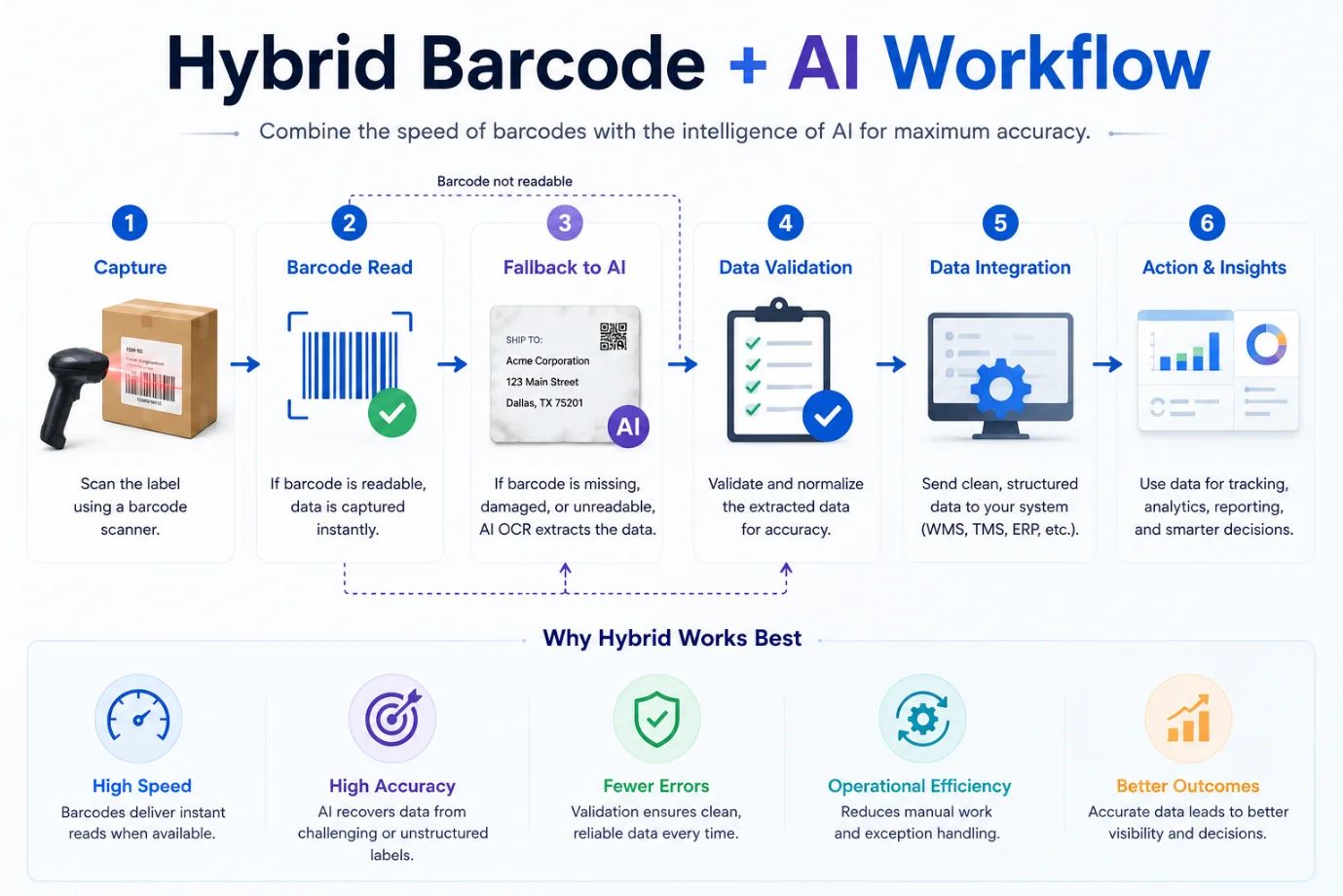
Hybrid approach (the smart middle ground):
Many leading logistics companies use both technologies together:
- •First pass: AI OCR scans the label image and extracts all data, flags low-confidence fields.
- •Quality gate: Confidence scores above 95% move to the shipping system automatically. Below 95%, the system attempts a barcode scan.
- •Fallback: If barcode scan succeeds, use that data. If it fails, send the label to a human reviewer.
This approach combines the speed of AI with the reliability of barcode scanning, dramatically reducing manual review and maintaining data quality.
Implementation Strategy and Best Practices
Deploying an intelligent shipping label processing system requires thoughtful planning and phased execution.
Phase 1: Assessment and Planning
- •Identify your current label sources – Which carriers, shippers, and suppliers provide labels? What's the variance in quality and format?
- •Measure failure rates – Track how often barcode scans fail, how often manual data entry occurs, and what percentage of shipments have address-related issues.
- •Map your data flow – Understand where label data enters your system, how it flows through your warehouse management system (WMS), and where errors typically occur.
- •Document pain points – Are address errors causing customer complaints? Are you losing time on manual corrections? Are compliance issues slipping through?
Phase 2: Pilot Testing
- •Select a representative sample – Choose a week of labels that reflects your typical mix: different carriers, conditions, label qualities.
- •Deploy alongside existing process – Run the new technology in parallel with your current system for 2–4 weeks. Don't replace anything yet.
- •Measure key metrics:
- •Extraction accuracy by field type
- •Processing speed per label
- •Percentage of labels flagged for manual review
- •Types of errors that occur
- •System uptime and reliability
- •Document integration points – Confirm how data flows into your WMS, accounting system, and carrier APIs.
Phase 3: Refinement and Rollout
- •Adjust configuration – Most systems have tuning options for accuracy thresholds, field validation rules, and exception handling.
- •Train your team – Operators need to understand when and how to review exceptions, how to flag data for model improvement, and what to do when the system encounters unusual labels.
- •Build monitoring dashboards – Track accuracy, processing time, exception rates, and system health in real time.
- •Plan for edge cases – Develop workflows for damaged labels, international shipments, unusual formats, or special handling situations.
Phase 4: Ongoing Optimization
- •Collect feedback from operators – They'll encounter label variations you didn't anticipate during testing.
- •Monitor accuracy trends – If accuracy drifts (often because carriers change label designs), work with your system provider to adjust.
- •Benchmark against targets – Compare actual performance to your pilot projections. If gaps exist, investigate and adjust.
- •Iterate on configuration – Most AI systems improve over time as they process more labels and encounter new variations.
Integration with Existing Systems
Successful automated label data capture deployment depends on seamless integration with your existing technology stack.
- •Warehouse Management System (WMS): Your WMS is the command center for fulfillment. Extracted label data must flow automatically into your WMS, triggering workflows, generating shipping manifests, and updating inventory. If you don't have developer resources, you can automate data entry into your WMS using Zapier.
- •Transportation Management System (TMS): A TMS optimizes routes, consolidates shipments, and manages carrier relationships. Clean, accurate address data from OCR improves TMS performance, enabling better consolidation and routing decisions.
- •Carrier APIs: If you use carrier APIs (FedEx, UPS, DHL, etc.) to validate addresses, request pickup, or generate labels, your OCR system should validate extracted data against carrier systems before finalizing shipments.
- •Address Validation Services: Third-party services like Smarty Streets or USPS Address Verification can validate and standardize addresses extracted by OCR. This catches misspellings, incomplete addresses, or invalid formats before they cause delivery issues.
Real-World Use Cases and Outcomes
E-commerce Fulfilment Center: A mid-sized fulfilment center handling 50,000 packages daily from multiple online marketplaces had a persistent problem: third-party sellers printed labels with varying quality and format. Barcode scanner failure rates hit 4%, requiring 2,000 manual interventions daily. The center deployed AI label recognition for initial data capture, with a barcode scanner as fallback. Result: Manual interventions dropped to 200 per day (1%). Address validation became automatic. Downstream address-related delivery failures dropped 40%.
Third-Party Logistics (3PL) Provider: A 3PL managing returns for 15 retailers faced constant label quality issues. Return labels came from different systems, printed on various media, and were often damaged or faded. Staff manually keyed return addresses, introducing errors that delayed refunds to customers. The provider implemented intelligent shipping label processing with automatic address validation. (To see exactly how they did this, read our guide on how 3PLs automate carrier tracking). Result: Return processing time dropped 30%. Address errors decreased from 5% to 0.3%.
The Future of Shipping Label Intelligence
The trajectory is clear. As barcode scanner vs AI OCR debates continue, the technology is rapidly maturing. Here's what's emerging:
- •Multi-modal intelligence: Future systems will combine barcode data, QR codes, weight sensors, photos of package condition, and even blockchain-based carrier tracking in a single unified data source.
- •Real-time anomaly detection: AI will flag suspicious patterns instantly (mismatched weights, addresses in high-fraud zones) allowing intervention before the package ships.
- •Autonomous exception handling: Instead of flagging exceptions for humans, systems will automatically reroute packages, notify customers of potential delays, or escalate to supervisors via intelligent workflows.
Conclusion
The choice between traditional barcode scanners and intelligent shipping label processing isn't binary. The most successful logistics operations recognize that both technologies serve complementary roles. Barcode scanners excel at speed and reliability when labels are high-quality and barcodes are properly printed. For simple workflows, they remain a proven choice.
Shipping label OCR software, powered by AI and machine learning, transforms label handling by extracting complete address data, detecting errors, and reducing manual touchpoints. For high-volume, multi-carrier, international, or quality-sensitive operations, the gains in accuracy, speed, and data completeness are compelling. The future of logistics isn't about choosing one technology over another—it's about building a system that's fast, accurate, and scalable.
Try PerfectParser Free
Extract data from your first documents today. No credit card required — 20 free credits included.
Start Extracting →FAQ
What's the difference between a barcode scanner and OCR software? Barcode scanners read encoded data from barcodes or QR codes. Shipping label OCR software reads printed text and images directly, extracting addresses, weights, and service levels in a single process. Scanners are faster for single barcodes; OCR captures more complete data in one step.
How accurate is shipping label OCR software compared to manual data entry? OCR achieves 95–99% accuracy on individual fields, while manual entry averages 1 error per 300 keystrokes. OCR also processes 10× faster—2–5 seconds per label versus 3–5 minutes manually.
What languages does shipping label OCR software support? Top systems support 50+ languages including English, Spanish, Mandarin, Arabic, and Cyrillic. Support varies by vendor, so verify language coverage for your specific regions before selecting a platform.
Can OCR read handwritten addresses on shipping labels? Yes, with 85–92% accuracy if handwriting is legible. Handwritten fields have lower confidence scores and may require human review, but modern AI systems handle them effectively as a fallback option.
How do I know if my operation needs AI-powered OCR versus barcode scanners? Use OCR if you have 3%+ barcode scan failures, process 10,000+ labels daily, receive labels from multiple carriers, need address validation, or operate internationally. A 2–4-week pilot with your actual label mix will confirm the value.